
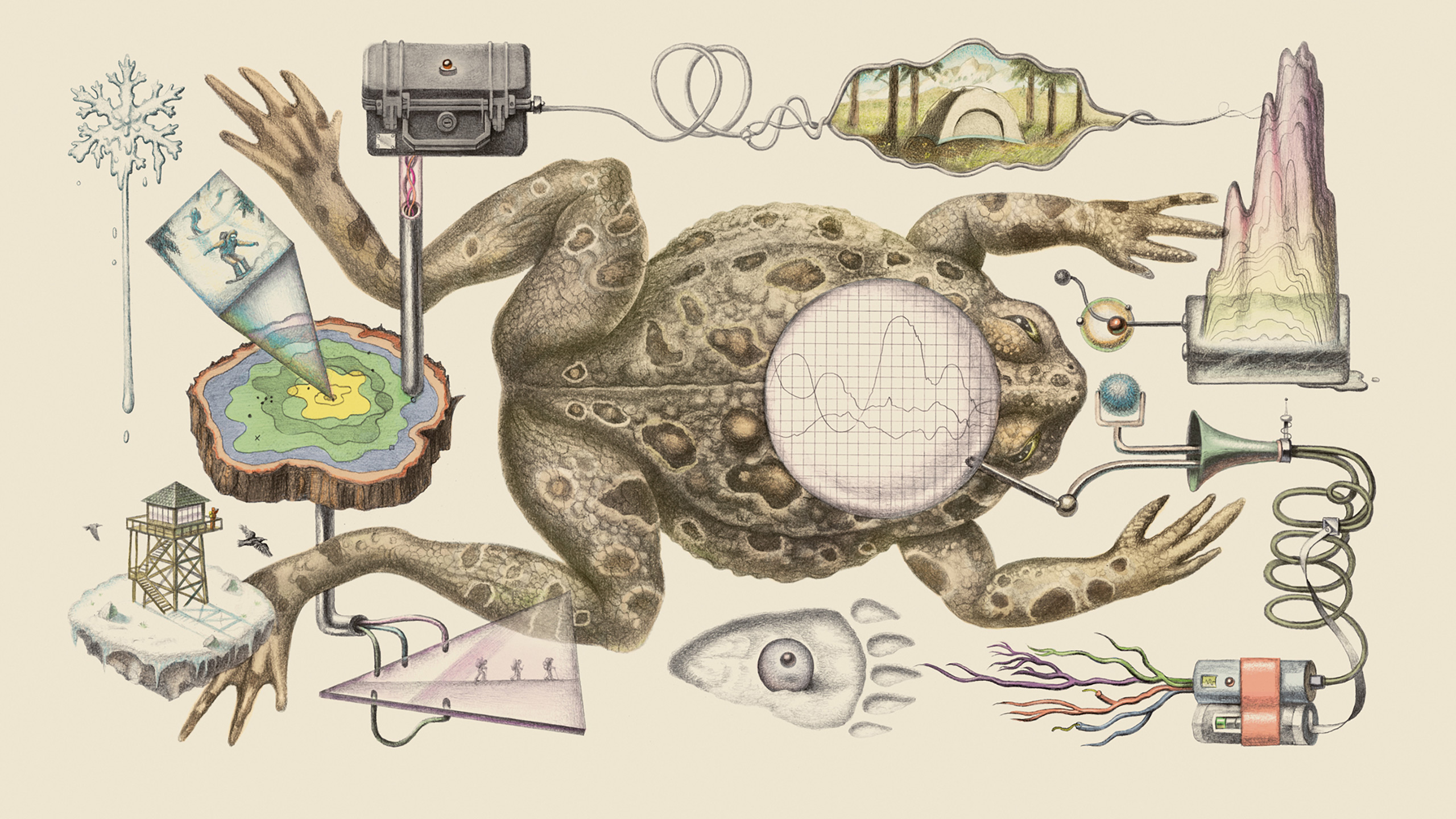
The basin was silent, save the wind and the occasional grokgrok of ravens circling the pale granite towers above us. Stone and sky and 10 feet of snow: the ravens were at home in the early April desolation of California’s High Sierra. We were just visitors while our food lasted, a scientist, two professional snowboarders, a guide, and a photographer, and there were more signs of death than life: rockfall and massive avalanche crowns and insects blown up from the valleys to the high snowfields. But lengthening days signaled the coming end of the winter austerity, and possibly the emergence of one of North America’s strangest alpinists: the Yosemite toad.
Two million years ago, some vagabond ancestral toads of California’s warm lowlands crept into the glacier-bound Sierra Nevada. From Tehipite Valley in the south to Carson Pass in the north, they went up to the high peaks and then refused to go back below 8,500 feet. There they evolved into the Yosemite toad, an animal found nowhere in the world except the High Sierra.
They spend half of every year buried under snow, tiny hearts beating a few times a minute, metabolizing insects eaten in November, a slow-motion life-or-death race between the depletion of banked energy reserves and the arrival of spring. Hibernating animals are closer to death than to sleep, and I know now that some lay waiting beneath our tracks.
Waiting. Waiting.
Most of the rest of the year they’re solitary and silent, small, brown creatures living among brown rocks. But every spring as melting snow floods high meadows and the birds and insects return, the toads gather and sing.
They’re waiting for this one chance to sing, and that is what brought us here with snowboards and heavy packs: to record that song.
Bioacoustics is an emerging field in ecology that uses animal sounds to answer questions about ecology and conservation. I got my start in bioacoustics as a graduate student at the University of Wisconsin–Madison in 2016, and over the next four years I developed a bioacoustic approach to monitoring spotted owls in the Sierra Nevada. Each summer, my team deployed and, a month later, retrieved shoebox-sized recorders across the mountains. We processed the resulting audio—first with “detectors” I made myself and now with a machine-learning algorithm— to extract the sounds of owls and other creatures and use patterns of those locations to track how species respond to disturbances (like increasingly massive fires) and how they change over time. The approach proved e!ective enough that the U.S. Forest Service (USFS) adopted it as a Sierra-wide monitoring tool.
At a wildlife conservation conference in early 2020, one of my Forest Service collaborators told me about the Yosemite toad. The population is declining, she said, but by how much and how rapidly is uncertain because the toads are so difficult to monitor.
The best time to study the toads is during their brief breeding season during spring snowmelt, because that’s when they’re doing their best to be found. For nearly two weeks, the males gather in meadows to sing all day, every day, while discerning females waddle through the fresh grass and freezing pools and evaluate their options (yes, they walk rather than hop!). The best time to study toads is also the worst time to move through the Sierra: the soft snow makes travel by any means nearly impossible, yet it is still extensive enough to bury the roads and trails to all but a few toad-friendly meadows.
As the snow melts, it floods high mountain meadows. The toads need meadows, not lakes, but meadows whose annual inundation lasts long enough for their aquatic tadpoles to metamorphose into terrestrial toads. If the flood lasts too long, fish can survive there and will devour the young. If the flood is too short, the tadpoles die of suffocation if their gills haven’t metamorphosed into lungs before the water disappears, or they die of heatstroke if the shallow water warms so much that it overheats their tiny bodies. Either way, I hope it’s fast. And during the Sierra’s ever more frequent low-snow years, they die by the thousands.
“Bioacoustics helped us scale up owl monitoring,” my colleague said. “Do you think it might work for the toad, too?”
I did. Not only that, but for me it would be a natural confluence of lifelong passions that had always coexisted, rather than interacted. As far back as my first J-term in 2008, I split my winter hours between classes for my conservation biology major, indoor track, and, four or five days a week, snowboarding at the Snowbowl.
It was always a balancing act, time stolen from any two passions to allow the third. After graduation in 2011, track ended, snowboarding got less time, and—after a two-year gap—classes increased, as I completed an MS and PhD in wildlife ecology. But studying the Yosemite toad would draw on all three.
If we went into the mountains in late winter on splitboards, snowboards that split in half lengthwise to serve as cross-country skis, we could deploy recording units before the breeding season and retrieve them by foot in summer. We’d avoid the spring slush and get data about the many areas that are never surveyed during that critical breeding time.
I’d need to train to haul several days of food, winter camping and safety gear, and the recorders into high-elevation mountains. I’d also need a local guide willing to lead a trip where snowboarding was the secondary objective. Jason Champion was the perfect candidate: part of the first generation of Sierra splitboarders, he is also one of relatively few people who have seen a Yosemite toad, which happened on a backpacking trip in Yosemite in the early 2000s. Amphibians are not very emotive, but something about the encounter stuck with him for decades. He was in.
We did a one-day trip in the spring of 2021 and a five-day expedition near Mammoth, California, in spring 2022. Jason then connected me with one of his friends and long-time riding partners to help retrieve the recorders in the summer. Nick Russell is a professional snowboarder who grew up in Vermont and is now based in the Sierra, where he’s become one of the best backcountry athletes in the business. At the time, Nick was preparing for a snowboard expedition to the Himalaya; a two-day backpacking trip retrieving heavy recording units fit right into the training program. As we hiked, I proposed another toad tour in a new area, to piece together a bigger picture of toad populations in places too hard to survey by conventional means.
The USFS monitoring notes for that particular basin are a grim embodiment of the toad’s status: “Hundreds of tadpoles and six females found in 2002; one adult female in 2005; nothing in 2008, 2011, 2014, 2020.”
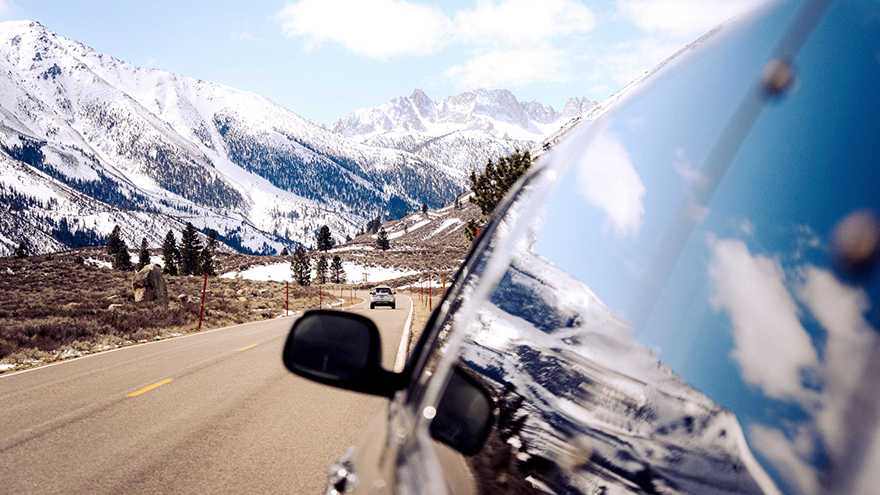
In spring 2025, Jason, Nick, and I met below the jagged ramparts of the Eastern Sierra for the third and biggest “toad tour.” We’d recruited two others: another pro snowboarder, Forrest Shearer, and photographer Christian Pondella. The others casually packed their gear in the April sunshine, mentally weighing today’s load against next week’s hunger. I distributed the recorders—black plastic cases the size of lunch boxes but, with six D batteries, weighing two-and-a-half pounds. I was feeling good but not relaxed: a six-day trip in the Sierra was more than even Nick had ever done, and he spends more nights in a tent than under a roof most winters. Moreover, despite the sun, the mountains felt ominous: a recent storm had dumped 40 inches of snow on our route and then battered it with 50 mph winds, and lingering squalls were still drifting through. It wasn’t your typical spring skiing weather, but at least the snowline was low enough that we could skin directly from the trailhead.
Shortly after noon, we set off. Our packs were heavy—60-odd pounds—yet I was thrilled to finally be moving along the route I’d scrutinized for months on screen. I’ve worked for the Sierra and its wildlife for a decade now, but mostly from a distance, living in the East and making short trips in the spring and summer to collect or help collect annual population monitoring data. As I leaned against a pine at camp that evening, exhausted, boots unlaced and propped on my pack, I sank into the realness of the place: the rough bark, the beckoning valleys, the darkening peaks, breathing the too-thin air of a place where a piece of my heart lives.
The next morning, we broke camp under calm blue skies and dropped down from our first pass into a shallow valley and up toward the second pass. I rotated to the front of the group to set the skin track, very conscious of the elite company behind me. Each of the rest of the crew had a decade or three of professional backcountry experience and had traveled the world for their craft. It still seemed like a small miracle that they’d signed up for the trip.
I’ve admired Nick and Forrest’s exploits for a long time, and I headed into the trip aware of the illusion of familiarity that social media fosters. A similar dissonance can emerge in bioacoustics: I’d collected thousands of hours of toad song before I ever encountered a toad, during the backpacking trip with Nick a few years before. We’d stumbled upon an adult female who’d lingered near a deep pool full of tadpoles. She was silent, as the females always are, her telltale white chin gently moving with each breath. I scrambled to the ground to meet her at eye level, trying to keep a respectful distance yet desperate to see her and maybe be seen myself.
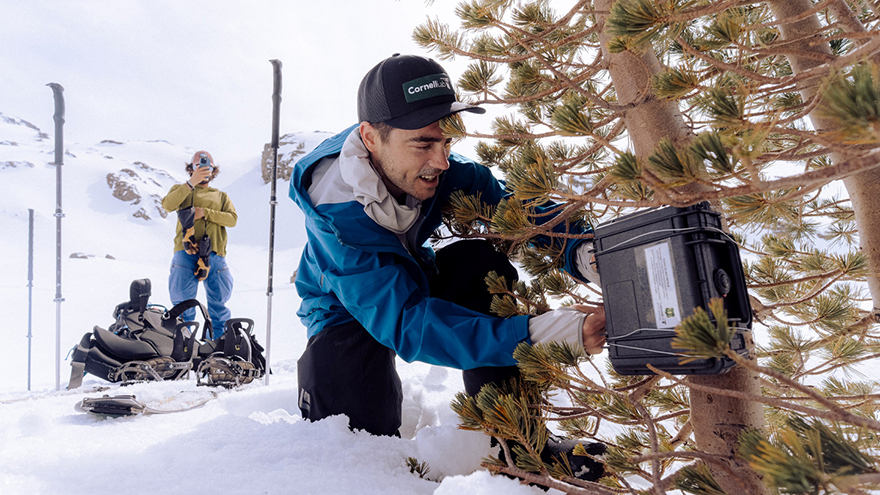
Like Jason, something about meeting the toad lingered with me, and it was a relief to finally reach our first toad meadow of the splitboard trip. It was a breeding zone below our third pass, where the toads seem to be hanging on. I deployed the first two units, double-checking that they were recording before snapping them shut and using baling wire to attach them to trees. For all the complexity it takes to get to these remote meadows, this part, at least, is usually easy.
We set up camp nearby. It wasn’t where we’d planned a basecamp, but heavy packs made for slow travel, and the plan needed to evolve. We slept poorly that night despite two days of hard travel, tents battered all night by a strong east wind. Our next target zone was two passes further into the Sierra, where the toads once sang but haven’t been found in over 20 years. But first, it was time to explore our new home. It was day three and we had yet to do any snowboarding, so our next move was obvious: there were lines all around us that needed to be ridden.
As Nick led us up a steep ramp out of the valley, we noticed we were not the first to take this route. Another set of tracks punched a near-vertical path toward the saddle above.
“If we were in Alaska, I’d say those were wolverine tracks,” Jason said. “Nothing else goes straight up a mountain like that.”
“It probably was a wolverine,” I said with a huge smile. One was caught on camera in Yosemite two years earlier, just the second time the burly carnivore has been spotted in California in a century. From the look of the wind-scoured prints, this one had been here just days before.
We spread out on the skin track to finish our own climb, each alone with his thoughts and the ever-expanding view, until we gathered at the ridgeline without a word.
Nick, Forrest, and Christian took o! immediately. Jason and I followed their track above a cliff and below a cornice on firm, high-angle snow. Reaching the top of my line, I caught my breath and cleared my mind. I’d trained for the physical side of the trip, skinning up my local Vermont ski resort with a 40-pound bag of dog food in my pack, but the mental challenge of making kick turns over exposure was another matter. Snapping my board back together and getting it on my feet, however, made all the di!erence. I dropped past the cli! and through a gap, swooping down into the bowl. At the bottom, I hunkered in the scant shade of a scrawny pine to watch the rest of the crew ride. They were in their element, smooth and decisive, honed by decades among these peaks. The mountains will change you if you let them. Just ask the Yosemite toad, which cannot heat its own body but would rather ride out the Sierra winter and its 350 inches of snow than leave the mountains. Half their life is hibernation, but passing the other half in the High Sierra makes it a good trade.
As the light turned gold, Nick, Forrest, and Christian went back for another lap while Jason and I cruised back to camp on what we called “the wolverine ramp,” 900 vertical feet of perfectly pitched turns. The others returned after sunset, and in the dark we prepared for an early start. Tomorrow would be big day. A toad day.
The problem with measuring the toad population in the summer isn’t just traveling on slushy snow; it’s also nearly impossible to get an accurate count.
By the time the trails and roads are clear enough to access the meadows by foot, the adults are solidary, silent, and scattered across the mountains. The monitoring teams are left to count egg masses, then tadpoles, then metamorphs—awkward half-toads whose tadpole tails shrink by the day— as the season progresses. But a single female can lay hundreds of eggs, so a plethora of eggs or tadpoles isn’t necessarily evidence of a healthy adult population. And finding only a few tadpoles late in the season is not necessarily evidence of a declining adult population, either. A single raven, for example, can gorge itself on tadpoles in matter of hours. I’ve watched them do it.
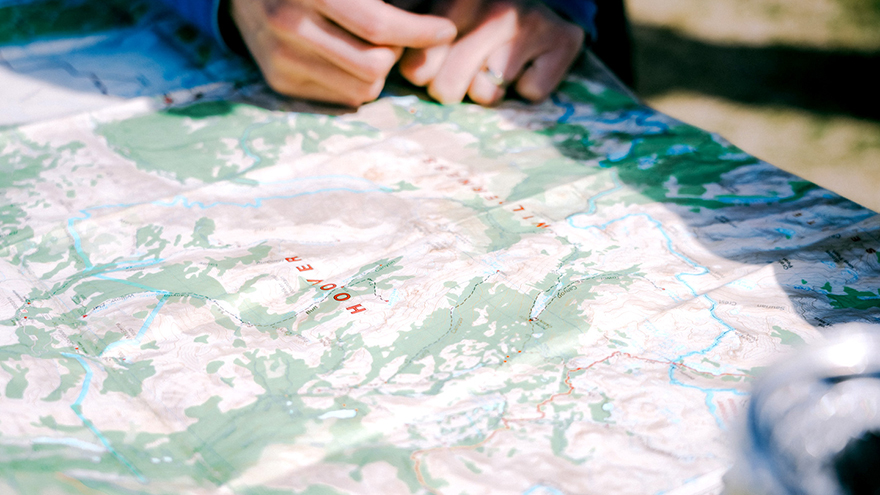
I’d chosen the day’s target zone because it embodied every challenge facing Yosemite toad monitoring: though Forest Service crews haven’t found tadpoles since 2002, it’s also so deep that they’ve never been able to survey it at breeding time.
In previous years, the Forest Service and I have put recorders out at the few meadows where the adult toads can actually be counted, so we can relate the acoustic data to the known toad counts and then apply that relationship to the backcountry recorders. If it all works, the bioacoustic approach could document the whole breeding cycle over far larger areas, freeing researchers from time or access constraints and o!ering insight into both the presence and size of adult populations. It o!ers hope for a better understanding of where the toad’s last strongholds are and thus how to protect the species.
Shortly after sunrise we continued westward into the heart of the Sierra, yo-yoing across valleys and high saddles. Five passes deep, we reached the target meadow and deployed the last three recorders. Forrest and Nick mounted the first unit, though it proved to be a struggle. It was the first and probably only time they were out of their element on the whole trip, and in a brief role reversal we agreed that I should check their work and take the lead on mounting the last two recorders.
Mission completed, it was time to make the long walk home. The view from the top of the deepest pass promised more mountains, more dream lines, and more toad meadows, but the clouds were rolling in, the sun was low, and we had, as the saying goes, miles to go before we slept. We turned reluctantly eastward and headed back to camp, arriving after sunset.
We started late on our last morning at basecamp, giving the snow time to ripen before our final turns in a place that, for a few days, we’d called home. A little joyriding, and then we broke camp. Eastward with a storm at our backs, over the passes and past bear tracks until the wind died down and the stars emerged. A final night in the mountains, then a final morning. Ready to be home, but not ready to leave. And as far as the recorders were concerned, there was nothing to do but wait until July to retrieve them. Wait, and hope.
There is no contradiction in the fact that two of the most memorable snowboard descents of my life were on a trip in search of a steeply declining species, because living without joy is as sure a defeat as allowing an extinction. The Yosemite toad lives by the snowpack and will die with it—a grim proposition it shares with the winter sports community.
That is a world that the five of us, at least, are determined not to see.
Why anyone should care about the very real possibility that the Yosemite toad goes extinct has a few possible answers. But I refuse to degrade the toad by justifying its existence. Any transactional basis for conservation will be subject to negotiation. And then it is doomed.
The toad owes us nothing. Instead, the obligation for justification lies with us: what reason could we give for inaction? Monitoring the toad, with bioacoustics or any other means, will not save it. But without monitoring we won’t know how we might give it a fighting chance. And just in California, the recent return of wolves and the tentative return of wolverines shows us that wildlife can seize a chance if we o!er one.
In July, Jason, Nick, and I returned to retrieve the recorders, walking dusty trails and high tundra to alpine meadows now carpeted in flowers. The units I’d deployed while kneeling in the snow were now 10 feet o! the ground. Against the odds, Forrest and Nick’s unit was still in its tree as well.
The three recorders from the deepest meadows revealed no toads, dashing my longshot hope that they’d snuck back to those meadows after 20 years of silence.
Then I reviewed the recorders from basecamp. For eight days in late May, the toads had been singing. For hours and hours, hopeful trills had rung out just feet from where we’d slept.
The meadows are not all silent. Not yet. Snow still falls, and the toads sing on.
Leave a Reply