
For more than 15 years, since graduating from Middlebury, I have spent my career as a white journalist immersed in Native American communities. I lived intermittently on the Fort Berthold Indian Reservation for eight of these years, documenting an oil boom and then a violent crime that became the subject of my first book. I have written stories about missing and murdered Indigenous women, the stealing of Indigenous children from their families, and non-Native people pretending to be Native. These days, people call me with stories they want me to tell. I used to think that eventually I’d write about other things, but now I see that this has become my life’s work. As I compose this story, I’m nearly finished writing a book about white guilt. The history of white people telling stories about Native people is largely a history of white people doing harm. I don’t want to repeat this harm—really, I want to make work that helps undo it—so I am aware of the stakes of the stories I write and of my responsibilities in writing them. I spend a lot of time asking how to do it well. I collaborate more with my sources than is typical for a journalist. I consult Indigenous scholars, read their books. But what I feel I lack, and what I often find myself craving, are models of other white people engaging ethically in their work with Native communities. So when I heard about Kathryn Bunn-Marcuse ’93, who is the director of the Bill Holm Center for the Study of Northwest Native Art at the Burke Museum in Seattle, I immediately wanted to know more about her. Like me, Bunn-Marcuse is white; like me she has spent her adult years working with and among Indigenous people; like me, she attended Middlebury College. I wrote to her, asking if we could meet, and she agreed.
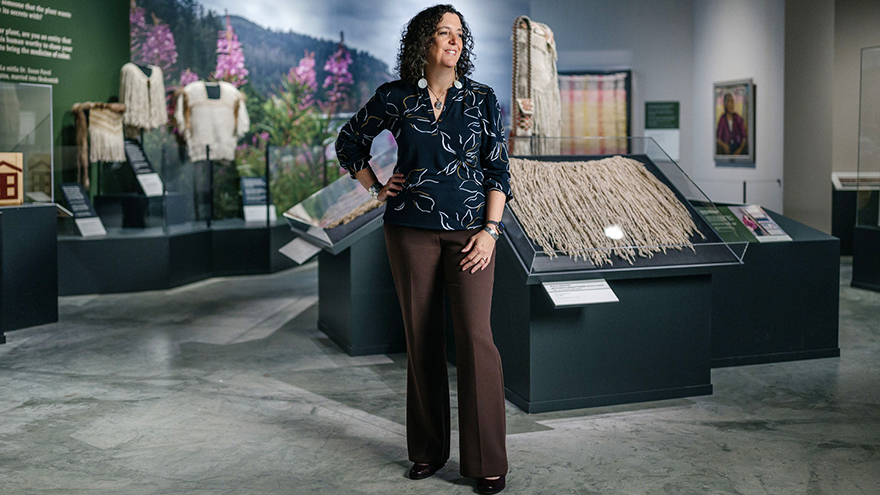
We met in early March at Café Allegro, a charmingly grungy co!ee shop on the west side of the University of Washington campus. Bunn-Marcuse arrived in black boots and a long, wool vest festooned with colorful weavings—made, I would learn, by a Haida fashion designer named Dorothy Grant. Her hair was curly and slightly damp, and she greeted me warmly, though I already sensed that her generosity with her time was at odds with her workload. In addition to administering programs at the Holm Center, Bunn-Marcuse curates Northwest Native art for the Burke Museum, teaches art history at UW, and has written and coedited multiple books. When people ask how she manages it all, she replies that she loves her job, but there’s “a lot of it,” she told me, laughing. “I try my best.”
One of the realities of living in a settler colonialist society like America is that when a non-Native person enters an Indigenous community, there is a long lineage of relationships with non-Native people preceding her, and many of these relationships are fraught. For a curator at a museum, this lineage is especially troubling: in the late 19th century, the U.S. formed a Bureau of Ethnology and tasked it with acquiring cultural relics and human remains to aid in the study of Indigenous people. Millions of belongings were subsequently brokered or stolen out of Native American and First Nations communities, then sequestered in archives thousands of miles from their places of origin, to which only scholars and museum professionals were granted access.
The Burke Museum at the University of Washington was one of the first cultural institutions in the nation to contend with this legacy. In 1968, it hired Bill Holm to be its curator of Northwest Coast art. Holm was white but for years had been studying a traditional visual style found in Haida, Tsimshian, and Tlingit art he called “formline”— composed of bold, curvilinear shapes that were often carved onto bentwood boxes and totem poles, woven into ceremonial robes, and etched onto silver bracelets. At the Burke, Holm reimagined the museum as a site of access, in resistance to the cold remove at which academic and cultural institutions had long held Indigenous people. He showed the collections to any Indigenous person who asked, many of them artists hoping to reconnect with their lost cultural belongings and study their ancestors’ craft. Over the course of his career, Holm and his colleague Robin Wright also identified and photographed 30,000 items that had originated in Northwest Coast communities and now were scattered in institutions around the world. Innumerable Indigenous artists have since relied on this archive to gain inspiration and instruction for their work.
The Burke changed in other important ways as well—becoming, in 1989, the first U.S. museum to cocurate with Indigenous people when it launched an exhibit in collaboration with 39 tribes across Washington State. Holm had retired by then. Museums across the country were changing, too: With the passage of the Native American Graves Protection and Repatriation Act in 1990, any U.S. institution receiving federal funds was required to inventory and report human remains and cultural belongings it held in its possession and return these items to tribes upon request.
In 2003, Wright founded the Holm Center, through which she initiated a grant program to cover travel expenses for Indigenous artists wanting to visit the collections, formalizing Holm’s ethos of access. Wright, who had been Holm’s graduate student, now had a student of her own—Bunn-Marcuse. The museum where Bunn-Marcuse now works is very di!erent from the Burke where Holm and even Wright spent their careers. Indigenous artists and their communities hold a more prominent and powerful position in American culture, and Northwest Coast artists are thriving, from those still hewing closely to styles like formline, to those reimagining the form, to those concerned less with traditional aesthetics than with contemporary questions.
Still, there is no escaping that “museums are colonial spaces,” Bunn-Marcuse told me. “They were put together under those circumstances”—circumstances that cannot be undone—“but we can do better.” And so her fundamental responsibility is perhaps the same as any curator’s ever was: To turn the museum, once a repository for the spoils of colonization, into a place where reconnection and relation with and among Indigenous people might be possible.
On a Monday afternoon, I joined Bunn-Marcuse for a Holm Center meeting. There were books and posters crowding the walls, baskets stacked on shelves, and butcher paper, scrawled with exhibit diagrams, taped to metal cabinets. The center had recently put out its annual call for grant proposals, and the team was especially excited that 21 Indigenous artists applied to visit the collections. Many of these grantees would use the funds to bring apprentices, mentors, and relatives. In a recent year, four generations of artists from one family had visited all at once.
In the course of a half hour, the team would discuss a recent fundraising event, who was footing a bill for the latest exhibit, thank you cards for donors, and how to arrange chairs for a panel discussion the next week. The panel was about their latest exhibit, Woven in Wool, which had so many collaborating curators that administrators at the Burke were asking how they could ensure everyone would fit onstage. “I’m like, ‘It will be fine! It’s like improv!’” Bunn-Marcuse said, throwing up her hands in self-parody, and her team laughed. “Okay,” she said, serious. They would make a plan.
A curator, like a writer, must constantly reassess her position relative to the story she is trying to tell, balancing her desire to disappear behind the scenes with the reality that she is still present, influencing and shaping the story. Bunn-Marcuse often quotes the “three R’s” of Indigenous methodologies from the Opaskwayak Cree scholar Shawn Wilson—“Respect, Relationships, and Reciprocity”—as the values that guide her work. (“And I would add Responsibility,” she told me.)
It is in fundraising where Bunn-Marcuse holds the most influence—and where cultural institutions have the most potential to reshape their practices, she believes. Her friend Jami Powell, who is Osage and the curator of Indigenous art at the Hood Museum of Art at Dartmouth College, once told her, “Budgets are moral documents.” “If you want policy change, you can advocate for policy change,” Bunn-Marcuse said. “Or, you can write your own grant and your own budget, and put in there something you want the museum to do. Then, the museum is required to do it, and if you do this enough times, you can begin to say, This is what we’ve always done. It’s not in our policies, but it’s in our practice.”
This concept came into sharp relief for Bunn-Marcuse when the center recently lost funding from the National Endowment for the Arts because their grant, she was informed, no longer met federal priorities. One priority that still qualifies for funding is “supporting tribal communities,” so Bunn-Marcuse appealed. “I said, ‘Here are all this exhibit supports tribal communities.’ They wrote back, ‘You’re not doing that. You’re just having an exhibit.’” This made her think: What is an exhibit? “Isn’t it a real contribution to public knowledge? There are polls that show museums are still one of the highest-trusted sources of information in the U.S. That’s particularly important right now, when people don’t know what information to trust.”
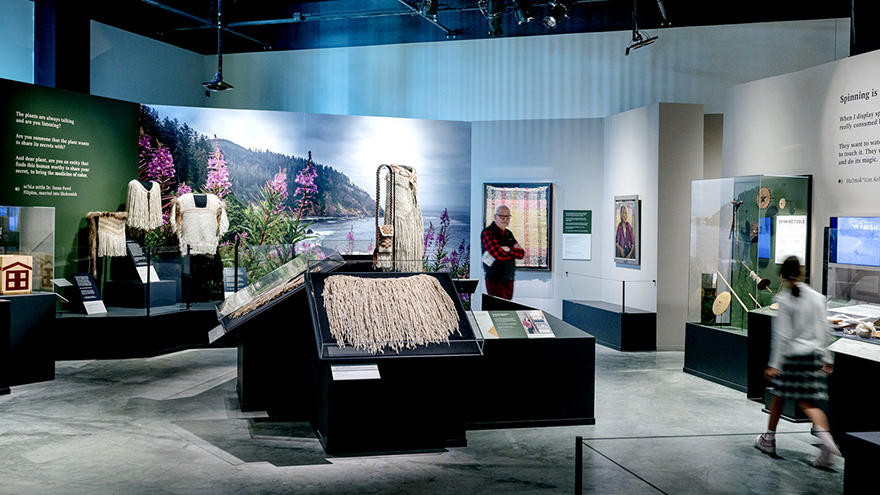
I returned to the Burke the next morning to tour the exhibit she was referencing. The idea for Woven in Wool came from the Coast Salish Wool Weaving Center, a collective of women weavers from tribes along the Northwest Coast. In 2019, their executive director, Dr. Susan Pavel, who is Filipina but married into the Skokomish tribe, pitched Bunn-Marcuse on a cocurated exhibit featuring wool regalia. The idea immediately appealed to Bunn-Marcuse, who has long felt that the work of Coast Salish women—and Indigenous women artists in general—is woefully unrecognized in the art world. In any museum collection, the vast majority of historical belongings—from clothing to beading, to basketry—were likely crafted by women, yet the commercial art market favors work traditionally made by men, such as carvings. “There is a phenomenal inequity between what men and women are paid for their creations,” Bunn-Marcuse told me. Weaving is a painstakingly intricate artform that demands deep cultural knowledge, muscle memory, fine motor coordination, and complex math. “Someone can carve a mask, or a bentwood box, or even a whole totem pole in far less time than it takes to make any of these wool creations.” Yet buyers are more likely to balk at the prices of even undervalued weavings.
Pavel and her team wanted Woven in Wool to display not just the work of Coast Salish weavers but also their process before weaving even begins, from the collecting of material, to the carding, dyeing, and spinning of wool. Traditional artists in the region primarily weave with mountain goat fur, but they will work in other natural fibers like swan down and flu! from cottonwood, fireweed, and cattail, which strengthens the yarn. Bunn-Marcuse had told me that this aspect of the exhibit presented some technical challenges: first, it had proven harder than expected to encapsulate flu! in an acrylic display box. As soon as a box was placed over a fluff pile, the pile burst and clung to the inner walls; so the team spritzed the fluff with hairspray before securing each box. Then there was the mountain goat pelt, which they were loath to put behind glass, but which was so fuzzy that visitors would be tempted to touch it. So they arranged cedar boughs in front of the display to deter impulsive petting.
I had never seen an exhibit in which the deliberations of its curators felt so present. Instead of making themselves invisible, the team had done the opposite, their process becoming the art itself. At the entrance was an invitation to “leave your worries and burdens at this threshold,” assuring us that “what you are about to experience was put together by a collaborative team of weavers and museum sta! with good intentions and love.” Once inside, I heard a murmur of voices, as though I’d entered a communal prayer. Speakers extended from the ceiling like showerheads, and as I stepped beneath one, a voice rose above the others, as clear as if the person were beside me. These were recorded interviews with the weavers—Pavel, as well as Bruce Miller, her Skokomish uncle who taught her to weave, Chief Janice George (Squamish), Gail White Eagle (Muckleshoot), Kelly Sullivan (Port Gamble S’Klallam), Tillie Jones (Tulalip), and others. Each of their weavings answered a call, George explained—to pass along “teachings that have brought us from almost being wiped out to today.” At one point, the Squamish Nation lost all but 200 people. “There are those few people that came through the keyhole, carrying what they had to give us. And everything we have today is because of those few people,” George said.
Maybe because I could now imagine the e!ort that had gone into them, the weavings seemed to shiver with life. Most were not colorful, the wool left white or dyed tawny, but something in their thick coils, in the crannies between warp and weft, implied movement. Bunn-Marcuse had told me that she often cries when she sees a new weaving for the first time. After all, it was the beauty of the art that drew her to it, even as a child. “Nothing is more beautiful than a robe when it’s being danced,” she said.
Bunn-Marcuse was born and raised in Honolulu, Hawaii, in the 1970s amid the start of the Hawaiian Sovereignty Movement, which brought renewed attention to the state’s illegal annexation by the U.S. in 1898. Native Hawaiians, facing widespread evictions, were rising up in protest of U.S. military presence and the burgeoning tourism industry. Her family is haole, white, but her community was mixed-race, and Bunn-Marcuse grew to understand the subtle language of multicultural relationality. “In Hawaii, you have friends of all different ethnicities,” she told me. “So you learn where the line is between appreciation and participation. There were things that came out of Hawaiian traditions that everyone could partake in, and things just for Native families. I think that helped me feel comfortable in places where I’m a minority.”
In the summers, her parents sent her to the San Juan Islands in Washington, to a camp where Bill Holm and his family o!ered cultural programming. Years earlier, Holm had befriended a Kwakwaka’wakw carver, Mungo Martin, and after that, generations of Martin’s family came to the camp to share their songs, dances, and artwork. Holm constructed a model of a “Big House,” a large cedar building found in many communities along the coast where clans host ceremonies, in which Holm and Martin’s descendants hosted “play potlatches” for campers. Even as a child, Bunn- Marcuse understood that, though Holm was white like her, he had a long, reciprocal relationship with the Kwakwaka’wakw family, which a!orded him some—though not all—privileges of engagement with their traditions.
When Bunn-Marcuse went on to major in art history at Middlebury, it did not yet occur to her that Northwest Coast art was a scholarly subject she might pursue. Few programs in the country taught Indigenous art, and Bunn-Marcuse’s classes were almost exclusively concerned with European works. She was enamored nonetheless, riveted by the stories her advisor, John Hunisak, told. “While he’s telling you about some tiny little church in Rome, he’s also telling you about going around the corner and running into the chaplain who had the keys to let him in to see the altar,” she recalled. “And he could show us eight different altarpieces that looked the same to me, but he had the perfect adjective to describe why this one was important relative to that one.”
When she was accepted into the master’s program at UW, she thought she would continue studying European art—until she met Robin Wright: “She told me what she did, and that’s when I realized that there was a whole body of scholarship around Northwest Coast art.” Over the following years, Bunn-Marcuse accompanied Wright to Kwakwaka’wakw territory on Vancouver Island, to Tlingit territory in Alaska, and to Haida Gwaii, an island off the coast of British Columbia, where Wright was working with artists to map the genealogy of Haida families. “She would be talking to people and making notes on a napkin, and then she’d go home and make these huge charts that filled whole rooms,” Bunn-Marcuse recalled. Wright would return to Haida Gwaii to share the charts, so families could edit them. This collaborative work required more time and patience than academic schedules typically allowed: “You spend lots of time having tea, talking about lots of things, and then hopefully, eventually, you talk about.”
It took Bunn-Marcuse a long time to learn how to slow down. She was working multiple jobs to fund her way through school, and now she had small children at home. “I’m an extrovert from a large family where a supportive conversation means that, as you finish your story, I’m going to come in on the last five words with my story. This is not the polite way for me to talk in most other rooms, particularly with elders, where the pacing is di!erent.”
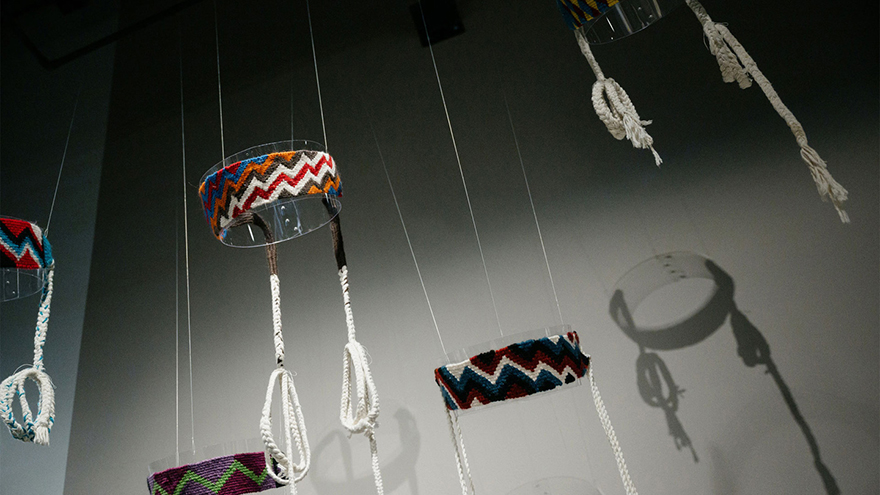
Bunn-Marcuse finished her PhD in 2007 and, seven years later, curated her first exhibit at the Burke, titled Here & Now: Native Artists Inspired. Her intention was to reveal the behindthe- scenes work at the Holm Center—to show how a museum can support the revitalization of Indigenous cultures and prod institutional change through meaningful relationships with artists. Opening the collections to emerging and established artists was important, she wrote in an essay about the exhibit, “because while art-making is flourishing in many Native communities—especially along the Northwest Coast— in other communities there are few teachers and even fewer historical artworks from which to learn.” All cultural creations in museums contain “the knowledge of their makers” and can be catalysts “for transferring this knowledge across generations.” The exhibit featured 15 artists who received grants from the center alongside pieces from the collections that inspired their work. Some of these artists had replicated historical items exactly, while others drew only subtly on old forms. All of them spoke about their process. “I found myself wondering who were these women?” the Tlingit weaver Shgen George said of studying a set of robes. George had noticed a human hair woven into one of the robes. “I just thought, ‘There’s a piece of the woman who made this.’” The Kwakwaka’wakw artist Lou-ann Ika’wega Neel had come to study works by her grandmother and great-grandfather but found herself repeatedly drawn to a rattle lying on one of the storage shelves. When she finally looked up the rattle in the collections catalogue, she learned it had been carved by her father, whom she never knew.
“What I have learned,” Bunn-Marcuse wrote, “is that historical Native American and First Nations art are kin. They want to be functional in service of a new generation— to teach and to reach across generations the way that parents, aunts and uncles, and ancestors do.”
This essay, which is collected in Unsettling Native Art Histories on the Northwest Coast, the book Bunn-Marcuse edited with the art historian Aldona Jonaitis and which includes essays by several Indigenous artists including Lou-ann Neel, was “the hardest thing I ever wrote,” Bunn-Marcuse told me. Art history is rarely written about within an ethics framework, so Bunn-Marcuse had to find guidance from the larger field of Indigenous studies. “At the same time, it was a manifesto,” she said, “and that feels sort of uncomfortable and indulgent, because if you’re thinking about these ethical questions all the time, you’re not centering yourself. You’re centering the artist or the community. You also don’t want to be like, Here is how we’re doing it right—and no one else does. It’s a progression, right? Every generation is learning new ways of doing things. And it really felt like, There’s been a sea change.” It seemed that scholars of Indigenous art history finally understood: The formal visual system of a work of art doesn’t matter as much as its relational connections.
Despite having spoken to me for hours, she seemed reenergized, light on her feet in the presence of her students.
I admitted to Bunn-Marcuse that my interest in her had actually begun with an interest in Bill Holm. My late mother-in-law, Rebecca Blanchard, had spent 38 years codirecting a gallery in Seattle that represented many of the Indigenous artists whom Holm mentored. She had told me about Holm—how he invented the term “formline” as well as a technical vocabulary that scholars and artists have used to describe the style ever since, and how a book he wrote on the subject informed a generation of Indigenous artists, many of whom became celebrated carvers, painters, and weavers, who themselves passed along their knowledge to the next generation.
I had been struck by this story, turning it over like a parable in my mind. While I knew that it was not uncommon for white scholars to venture into Indigenous communities and write authoritatively about Indigenous cultures, it was uncommon for these scholars to earn and sustain the respect of the communities, as it seemed Holm had done. And still I didn’t know what to make of the story. Holm helped popularize an art form that for decades was stifled by federal laws prohibiting the ceremonial gatherings for which the art was traditionally made. His scholarship existed only because colonization made it necessary. And what did it mean for a white person, whose worldview had been shaped by colonial systems, to become a medium for an Indigenous art form? What was lost in his translation?
Bunn-Marcuse helped me parse this story, which is one piece in the lineage of relationships that preceded her. She admired Holm deeply, she said. He mentored her through her dissertation and became like a grandfather to her children. She also saw firsthand how grateful many Indigenous artists were to him. Yet it troubles her that many stories “deify” Holm, falsely crediting him with reviving Northwest Coast art. Holm never considered himself the white savior these stories cast him as, rescuing cultures from oblivion—that work was done by the artists themselves. And while his scholarship on formline was “hugely helpful,” Bunn-Marcuse said, she thinks of it as a template from which people can build. She sent me a recording of a talk she gave in 2024, during which Indigenous attendees told her they were rediscovering words in their languages and creating new ones for the English terms Holm applied to formline shapes.
These are the kinds of nuanced questions Bunn-Marcuse navigates in her work. The influence of white people also often raises questions about authenticity: How are we to value works of Indigenous art that may contain non-Indigenous aesthetics? The study of Northwest Coast art, in particular, reveals how long European and Indigenous cultures have been influencing one another. Bunn-Marcuse wrote her dissertation on engraved silver bracelets, a popular art form among Northern Coast communities in the mid- to late-19th century—crafted from melted silver dollars. She noticed also the way certain Euro-American imagery, such as the American eagles common in Victorian art, were appropriated by Indigenous artists into their own iconography. Then there is the fact that European Surrealist artists in the early 20th century appropriated Tlingit, Yup’ik, and Inupiaq forms. The idea that appropriation is a fundamental mechanism of an evolving culture isn’t contested, Bunn-Marcuse told me. “But I think the political realm we live in forces people into essentializing, to protect themselves from ongoing assimilation or appropriation by non-Native people.” This makes sense given that the history of Indigenous and non-Indigenous relations in the Americas has been mostly unidirectional, the latter stealing from the former. “There is a need to say, This is ours, in order to protect it.”
When a non-Native person enters an Indigenous space, what matters most of all are the long-term relationships she commits to building, Bunn-Marcuse emphasized. I thought of Susan Pavel at the Coast Salish Weaving Center, who was taught to weave by her Skokomish uncle Bruce Miller after she married into the tribe. Bunn-Marcuse said Pavel would have insight into the trickiness of a job positioned where Native and non-Native worlds meet. “Indian Country is an entity unto itself, with layers of relationships that you didn’t create but are inheriting,” Pavel told me. “I think Katie [Bunn-Marcuse] comes at it with a very good heart and a stellar work ethic. She works very hard at understanding what is not being spoken.”
Pavel also told me she fielded criticism in the past for being a non-Native making Native art, but when she thought about the gift her uncle gave her and the relationships she had formed with her weaving sisters, it became clear: “My job is to be a link in this chain of knowledge that will continue well past my lifetime. I’m just one link, but I’m going to be the strongest link that I can be.”
In her own way, too, Bunn-Marcuse is a link in the chain. The first class she ever took on Northwest Coast art is one she now teaches, in a cavernous lecture hall at the center of the UW campus. Despite having spoken to me for hours, she seemed reenergized, light on her feet in the presence of her students. “It’s another beautiful day in Coast Salish territory,” she began, then pointed to a screen at the front of the hall, where she had been playing two videos by the Tlingit-Unangax multimedia artist Nicholas Galanin—one in which a man in street clothes performs a break dance to traditional music; the other in which a performer, dressed in regalia, steps to electronic beats. Galanin, she would explain, is versed in traditional practices like carving, but much of his art is conceptual and performance based: “He really likes to push, break some of the structures of institutions that have been defined by white colonial practices.” At the Seattle Art Museum a few years ago, his installation Take a Knee and Scream until You Can’t Breathe asked viewers to do just that, alarming other visitors unaccustomed to encountering such raw emotion inside a museum.
“Everything is about context,” Bunn-Marcuse likes to tell her students. That day, her lecture was about how art making and tribal political sovereignty are inseparable. It was the end of the quarter, and her students defined “sovereignty” with ease, before Bunn-Marcuse led them through a history of U.S. and Canadian laws that e!ectively barred many Indigenous people from making art.
Next, she showed a painting by Lawrence Paul Yuxweluptun (Tsartlip-Syilx) that integrates formline with Surrealism, and a video in which he calls himself a “realist”—“ I’m just recording history, and sometimes it’s a nasty world.”
What did students make of this? One named Andi raised her hand. She had learned in another class that Surrealism was appropriated by Caribbean artists “to depict the grotesqueness of their experience, because the experiences of people under colonialism are so disturbing,” she said. “It’s to capture how viscerally they feel the effects.”
Bunn-Marcuse beamed. “Wow,” she said after we’d left the classroom, pleased with how her students seemed to understand the context in which Northwest Coast art has been made. “Andi made that class so much better. I hate grading, but then you go to teach, and at the end of the day, you think, ‘I did a thing!’”
It was indeed a beautiful day, the sun shining, the cherry trees a few weeks shy of blooming. I asked Bunn-Marcuse if she had seen Galanin’s installation at the Seattle Art Museum those years ago. She had, she said, and she had kneeled, but she couldn’t bring herself to scream. It hadn’t felt like her place to let all that emotion out, to partake in that catharsis.
Would I have felt similarly? Maybe this was Galanin’s point, I thought—to force the viewer to ask herself, Who am I in relation to you? In relation to Bunn-Marcuse, I, too, was part of her chain: Here was someone I could learn from.
Sierra Crane Murdoch ’09.5, a Pulitzer Prize finalist, is the author of Yellow Bird: Oil, Murder, and a Woman’s Search for Justice in Indian Country and the forthcoming Imaginary Brightness: An Autobiography of American Innocence, an examination of whiteness in relation to Indigeneity.
Leave a Reply