
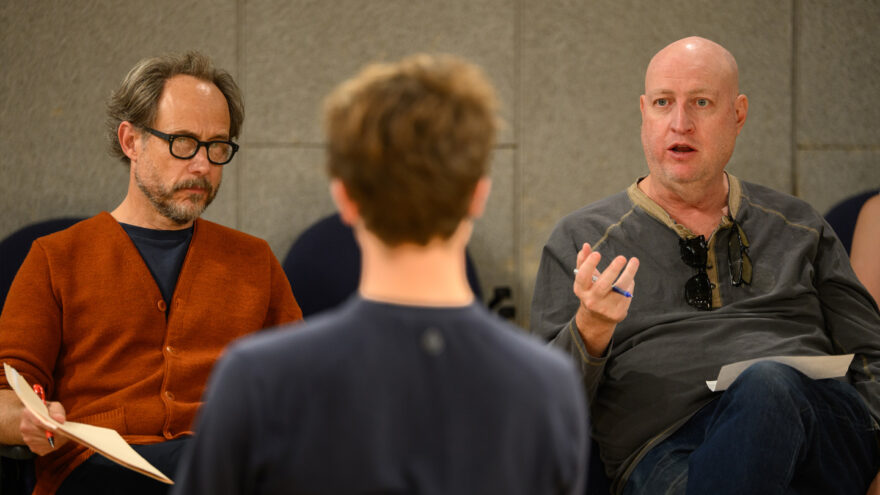
“When do you think an audition begins?”
Hollywood showrunner Shawn Ryan ’88, best known for series such as The Shield, S.W.A.T, Terriers, and The Night Agent, was standing before about a dozen acting students in a Mahaney Arts Center classroom on a late-October afternoon.
The fledgling actors considered his question; some looked down at the floor, others shared quick glances.
“When the actor walks into the audition room?” one offered.
“That’s a good answer,” Ryan said. “It makes sense. But an audition begins before the actor enters the building. It has begun when they arrive at the location, when they are walking through the parking lot. That’s when first impressions are made.”
Ryan went on to relate his own experience casting a show, a time when he encountered an actor shouting into a cell phone while standing on a street corner before a scheduled audition.
“He was not being kind to the person on the other end of the phone,” Ryan said. “And it made me think, ‘Do I want to work with that person?’”
The assembled students listened silently, appearing to take mental notes. A few might even have conducted a quick self-audit of their own behavior in the moments prior to Ryan opening the session.
If there was a lesson to be learned, it would be just that—a teaching moment, as Ryan wasn’t casting a real show but was rather conducting mock screen auditions while on a visit to Vermont last week. On this day, he was joined by his former classmate Alex Draper ’88, now a theatre professor and chair of the Theatre Department, and Meghan Leathers ’14, a professional actor and an artist in residence at Middlebury for the semester.
Interested students were provided in advance with a selection of “sides”—excerpts of scripts—from various shows including, among others, The Big Bang Theory, Riverdale, Search Party, and Ryan’s own Mad Dogs and The Night Agent. Students who signed up were given the opportunity to perform the scene of their choice for Ryan, as casting director, with Draper and Leathers servings as casting assistants and scene reading partners to the students.
Each year for about a decade, Ryan has, online or in person, conducted various workshops with students in Draper’s advanced acting classes. This year’s workshop, however, wasn’t associated with any class, so students with a wide range of acting experience, from first-years to seniors, were able to take part. Ryan started the workshop by saying he would be focusing not on acting broadly, but on the subtle differences between screen acting and stage acting. “Acting for the camera is different than projecting to the back row.” Ryan had students stand just a few feet away from him, much closer to a casting director than they would find themselves in a stage audition.
To approximate an actual audition, each student was asked to wait outside the room just before their turn. Ryan, Draper, and Leathers then guided them, one by one, through the typical steps of an audition: being called in, introducing themselves, taking a moment to get into character, nodding to their scene-reading partners when they were ready to begin, and, when finished, holding their expressions for a moment to let the camera (imaginary, in this case), linger before cutting.
Ryan had each student run through their part twice: once as they had rehearsed it, and again with his feedback. Each time, his small adjustments—such as to remind the actor of the character’s tragic backstory or to ask the actor to do their second read with a more hopeful, or perhaps more jaded, attitude—yielded subtle but noticeable improvements to their performances.
Over the course of two-plus hours, including a Q&A at the end, Ryan not only coached each of the students on acting for the camera but also gave general tips for screen auditions. For example, he advised them to choose characters who felt somewhat familiar. “As you’re breaking in, you’ve got to play some sort of version of yourself first.”
He praised one student for showing up “off book,” meaning with his lines memorized. Such preparation is not mandatory, Ryan said, but the camera can see more of an actor’s facial expressions when they aren’t looking down at the script. “So much of acting, it’s in the eyes.” Auditioning off book can also suggested that an actor takes their craft seriously.
Other coaching from Ryan, with additional input from Draper and Leathers, included how to dress for an audition, how to interact with a reading partner, and how to produce—but not overproduce—a “self-tape,” a recorded audition made remotely and submitted electronically. As far as handling the stress of auditioning, Ryan told the students not to be too intimidated by the casting director. “All the casting people that you’re working with, the people on this side, we really want you to be good. We want you to solve our problems. We want to be like, ‘Oh, thank God this person showed up.’”
During the Q&A, students asked how someone new to the business can even get a TV audition. “It’s hard,” Ryan said. He suggested that they start by getting more stage experience before worrying about screen auditions. “The first step is to take any chance to act,” he said, not only to add to their list of credits, but also to get exposure. “Act in a play. You never know who might come to see it.”
Ryan said students could look up producers they found in show credits and submit unsolicited self-tapes. But he urged them first to hang out in circles where they were likely to meet other people in the entertainment industry. That could be by working on set as a production assistant, for example. In Ryan’s case, he played basketball three days a week with people like a young George Clooney (“pre-ER”) and Bill Lawrence, creator of Scrubs and Ted Lasso.
Draper later said that, as much as any aspiring actor dreams of instant success, it’s rare. “For most people, when they say they’ve been discovered overnight, that’s a PR thing. You find out they’ve been auditioning since they were 11.” Luck and talent have their place, he admitted, but persistence is key. “You have to put in the legwork.”
Ryan expressed a similar sentiment. Although technology has made it possible to network and audition remotely, he encouraged students who might move to New York City or LA for acting to resist the temptation to rely on their laptops and phone cameras to land roles. “Put yourself out in the world,” he told them, as the workshop wrapped up. “You’re not going to get discovered in your apartment.”
Leave a Reply