
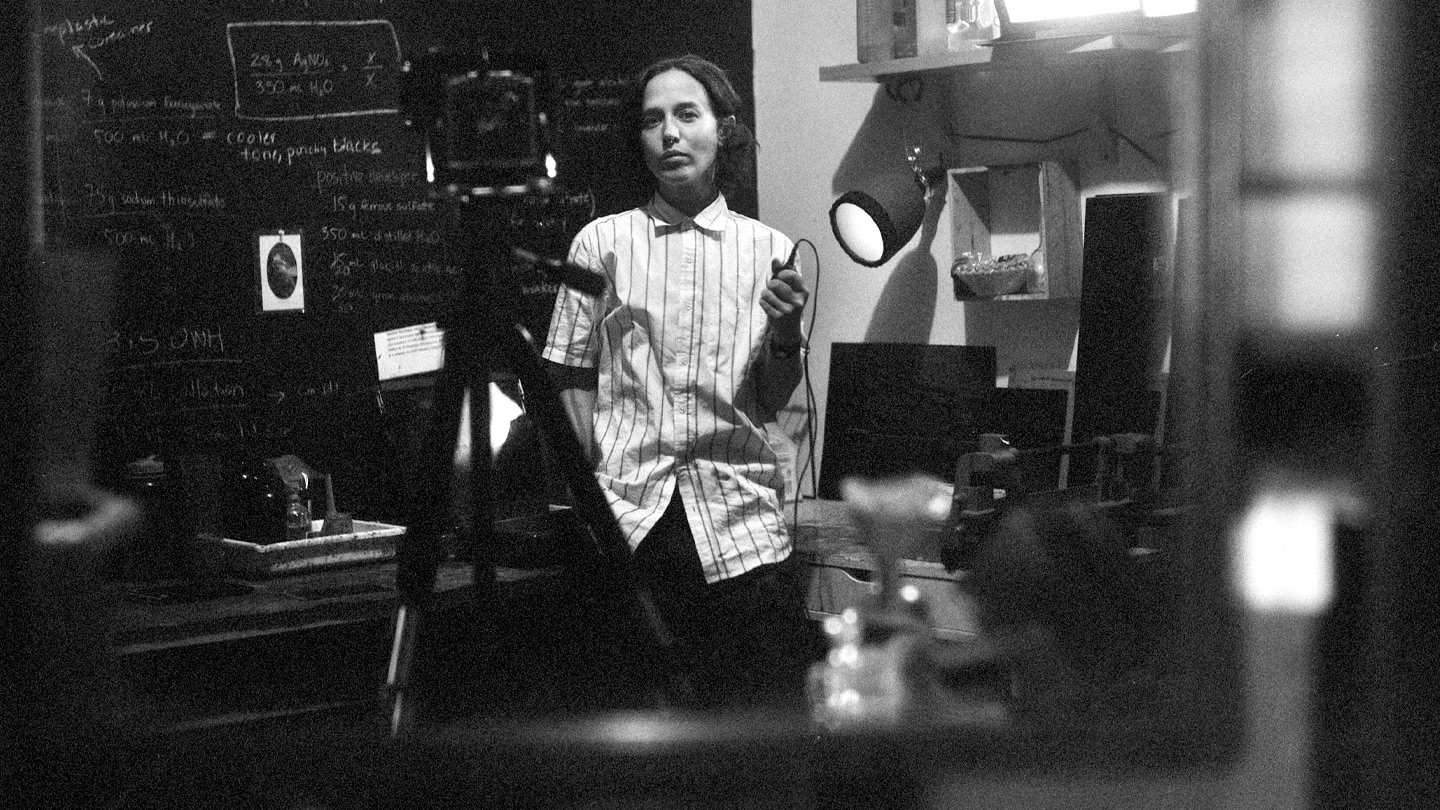
Em White ’13 wants you to know that she only owns four large-format cameras—a few 8x10s and a more portable 4×5 —that date to the 19th century. “I’m not a hoarder,” she says, with a laugh. “And every camera I own is functional. If I can’t use it, I won’t keep it. I don’t keep beautiful vanity vintage cameras just to look nice on a shelf.”
The cameras that she does own use film or glass plates (four by five inches, say, or eight by ten, thus the naming conventions) that make images using handmade processes that date to the mid-1800s. White is best known for using a process called wet-plate collodion, in which tin or glass plates are coated in a chemical solution, loaded into a holder that is then affixed to the camera, and developed while the plate is still wet. (Images are captured by removing a lens cap, with varying degrees of exposure.)
The whole process takes about 15 minutes, necessitating a mobile darkroom, which White currently has in the back of her maroon 2004 Honda CRV (“My dream car in high school,” White quips, “though I didn’t get mine until I was 27”). Made from a hydroponic growth tent, White’s mobile darkroom is “naturally light tight” and flexible, so she can pop it up or break it down in minutes, which is essential to her. “It’s important to me that I’m able to drive down a back road and if something catches my eye, I can pull over and—‘boop, boop, quick setup’—take a picture. If it took me 40 minutes to get everything set up, that’d be an inhibition for me.”
When she makes tintypes, the finished plate is one of one—“the object you hold is the only one that exists.” And with the glass plates, she gets instant feedback by developing them on-site.
“A large-format camera doesn’t render images the way your eye sees them,” she says. “The focus could be different, and different exposures can create vastly different results.” By developing the plates in the field she’s able to refine her approach to a scene, creating many glass negatives, which she will later bring back to her studio darkroom and enlarge to make prints.
“One of my favorite things about this process is that there’s a lot of ritual to it,” White says. “There are a lot of things that force you to move slowly, which helps me because I’m naturally energetic.”
She says that the discipline focuses her, compelling her to think about what she is intending to capture.
Though she has a robust studio portrait business, what originally drew White to the art form and what continues to motivate her today is documentary photography. She grew up one of five kids on a family farm in central Virginia, in a rural part of the state; her first body of work was documenting the changes to the farm and surrounding countryside when she returned to the state after college.
“My relationship to the outdoors has always been one of exploration, excitement, fear,” she says. “It’s a space of discovery, a space of self-actualization, of independence.”
She says that the rural area where she grew up “is pretty mundane—we don’t have mountains . . .it’s just farmland, with a beautiful river.” Yet she had—and continues to have—an intimate relationship with this otherwise ordinary place, which renders it, in her mind, spectacular. And what she sets out to do with her photography of this landscape is to afford others an opportunity to connect in their own way.
“At the core of photography is a documenting act,” she says. “You can’t separate the two.” And by committing herself to this documentation, White says she is demonstrating the sublime in the otherwise mundane.
“By photographing something, I’m communicating significance,” she says.
The James River features prominently in her work; she and her brothers grew up swimming its waters. “I think it’s beautiful, but so much of that perspective is based on my lived experience,” she says. So to convey that beauty to others, she focuses on what’s meaningful to her—an otherwise ordinary bend in the river, say—and then employs her very deliberate approach to the art form to create something meaningful.
When she sets up her tripod along the James or outside a Fluvanna County barn collapsing inward upon itself, White is making a commitment—of time and effort, yes, but also a commitment to the place and to the moment. For each exposure and hustled trip across uneven ground to the mobile darkroom in the back of the Honda and back again, to the hours spent later in the studio darkroom making large prints from glass negatives, White is signaling that the effort, itself, stands for something larger. “I feel like it’s an act of reverence,” she says.
The first time Em White entered a darkroom was during her final J-term at Middlebury when she took an introductory photography course. She had always loved taking photos; during her time abroad in Spain, she landed an internship with a fashion designer and shot a lot of film. But this was her initial exposure to analog photography, developing her own film, and she was hooked.
She subsequently transitioned to her 19th-century approach after graduating, when she was invited to take part in an off-the-grid artist residency led by friend and classmate Otto Pierce ’13. “I remember thinking ‘How do you do photography without running water or electricity?’ And then I was like ‘Didn’t photography exist before electricity?’” (Ultimately, White didn’t take part that year in what became the wildly successful Sable Project, which still runs today. White did manage to attend in 2019.)
Though her techniques are rooted in an approach founded more than 200 years ago, White says she’s not interested in historical recreation. She feels that that perspective romanticizes the past in a way that devalues the present. Rather, she hopes that her deliberate approach, with all its imperfections—evidence of handling, of the chemical process, of scratches on the glass plates—renders an experience that is inherently real.
A natural landscape, slowed down, approached with reverence, and handled with care.
Leave a Reply