

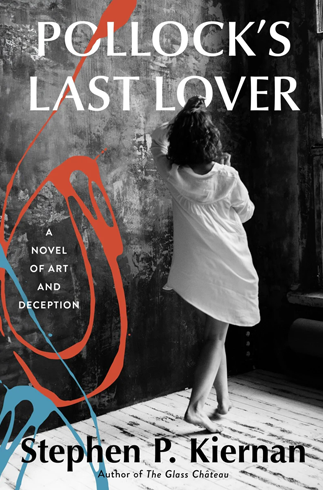
The beaches of Long Island. The streets and bars of New York City’s West Village. The cluttered interior of a long-occupied brownstone. A grave in a wind-whipped cemetery. Locations are as important as the characters across two timelines—the 1950s and the early 2000s—in Pollock’s Last Lover: A Novel of Art and Deception, the newest novel by Stephen P. Kiernan ’82 (William Morrow, 2026).
The title refers to Ruth Kligman, who was involved with the abstract expressionist Jackson Pollock when she was a young woman and he was a middle-aged, married man. The painter famously met his end in the summer of 1956 in a single-car accident at the end of Long Island. Pollock was driving drunk and speeding when his car veered off the road and he was thrown from the convertible. He wasn’t alone—he was with his lover, Kligman, not his wife, the painter Lee Krasner. Kligman’s friend was in the car as well. Kligman survived; Pollock and the friend did not.
Kiernan’s novel goes back and forth between Kligman’s time with Pollock and the early 2000s when a young woman at a modest art auction house is approached by Kligman to sell what she says is Pollock’s final painting. Gwen is tasked by her employer with determining whether the painting is real—and as her explorations unfold, she learns more about Kligman’s own career as an artist, her relationship with Pollock and other prominent figures in 20th-century art, and what could have contributed to the crash that ended Pollock’s life. In alternating chapters, we follow Kligman’s journey from New Jersey ingenue to New York model to the erratic, alcoholic Pollock muse. In both storylines, the characters navigate their way across New York City and Long Island and over and around patriarchal barriers as they each find their way to their own sense of self.
The mystery of whether the painting Kligman wants to sell really is a Pollock is based on real-life events, as are many (although not all) of the characters and events in the novel. As in Kiernan’s prior novels, the plot here is carefully researched and filled with historic details, period references, and marginal characters who were famous in their own right, including Willem de Kooning, Peggy Guggenheim, and Alfonso Ossorio. A rich and layered read, Pollock’s Last Lover might change the way you think about art and the value we place on it.
Leave a Reply