
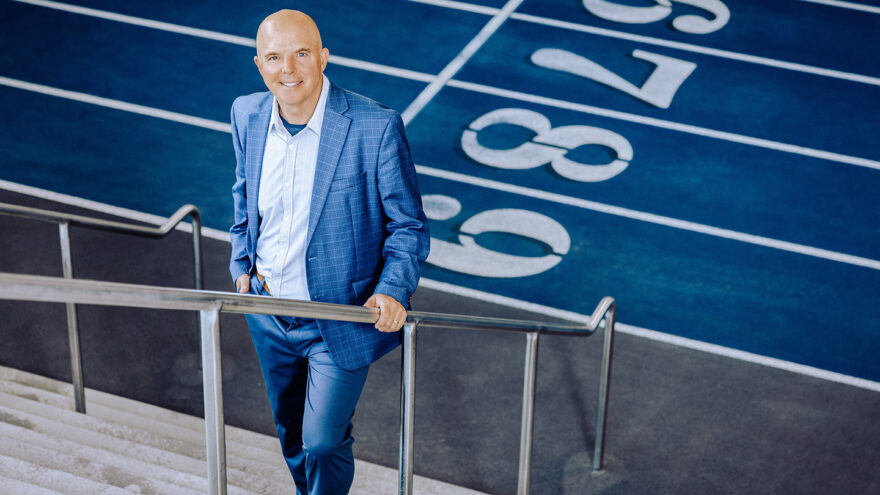
A June morning found Erin Quinn ’86 in his office in the Peterson Family Athletics Center. Stacked moving boxes lined one side of the room; atop one box rested a faded Middlebury ball cap with a long feather protruding from the back. (“That was Peter Kohn’s last hat,” Quinn said. He plans on giving it to Dave Campbell ’00, the men’s lacrosse coach.)
An apple sat on an uncluttered desk, and a series of trophies lined the tops of low-slung bookshelves; these would remain for the office’s next occupant, Todd Phelps, who was recently named Quinn’s successor as the College’s director of athletics. With just a few weeks remaining in his tenure as the Panther AD, Quinn settled into a comfortable chair opposite Matt Jennings for a midmorning conversation. What follows has been edited for clarity and length.
So, I’m going to start by perhaps embarrassing you a little bit . . . [Slides a copy of the fall 2007 issue of this magazine across a small table; it’s opened to a story titled “Mr. Unconventional” and features a photograph of a youthful Quinn, in shirt and tie, holding a soccer ball.]
Yeah.
Chuckles]
You had been in the AD job for a year.
I remember this piece; I distinctly remember the photo.
I’m cringing at the headline I wrote then: “Mr. Unconvential”. I don’t think of you as being unconventional at all, but maybe that’s just perspective, seeing you in this job for 20 years. You seem conventionally “Erin”—
You’re being hard on yourself. I think it’s a fair headline.
Because you had never been an administrator before? I think that’s what I was getting at.
Yeah, and before that I coached lacrosse yet had never played . . .
OK. I feel better about it.
[Laughs]
I guess what I’m saying now is that you seem to have always done conventional things (collegiate athlete, coach, athletic administrator) in an unconventional way—but you made it seem conventional for you.
That sounds right.
When you were a student-athlete at Middlebury, when did you think you might want to coach?
I didn’t, not really. The fall after I graduated, I accepted a part-time position coaching football, but it was basically something to do until I started Officer Candidate School in January 1987.
You were going into the military?
Yeah. I thought this was a way to still be an athlete. I thought I would go to Airborne School or Ranger School— learn more about being a leader, challenge myself, push myself. But I had a few football injuries that didn’t heal; I thought that with time and by no longer playing, these injuries would heal, but that didn’t happen. I physically wasn’t able to go further, and my military commitment was forgiven. And then Jim Grube, Middlebury’s lacrosse coach, asked if I wanted to stay on for the spring to coach lacrosse.
And you were a coach.
I was a coach. [Laughs] Though I guess I still didn’t know exactly what I was going to do. I moved around a bit: Tufts, Lake Forest. I thought about maybe being a high school teacher and coach. Or maybe something else altogether.
OK.
Until I came back here in 1990, as an assistant coach for football and lacrosse. I remember calling my parents and saying, “I think I’m a coach. This is what I want to do.”
You were promoted to head men’s lacrosse coach a year later, a position you held for 15 years. At what point did you start to think you might want to be an administrator? Was it always a goal? To coach for a set number of years and then move into administration?
It was a gradual thought process. I remember having conversations with [then AD] Russ Reilly in 2000, 2001. . . . At the time, I thought he’d be in the job for another 10 years or so, and I thought in that time I’d be ready for a change. So I would talk to him about what the experience was like for him, what I might need to do to get administrative experience. Then he surprised all of us by announcing his retirement a few years later.
At that point, you were at the pinnacle of collegiate lacrosse. You had won three straight D-III national titles (in 1999, 2000, 2001); Division I schools were calling. Was there a hesitancy on your part to leave coaching when things were going so well?
I was 100 percent into coaching. Things couldn’t have been better. I was flattered by the interest from Division I schools, but I wasn’t going to leave Middlebury. I loved my job and wasn’t interested in leaving it. I did not think of myself as being done with coaching. But. But. I didn’t want to wait until I was tired of coaching to take an administrative role. I didn’t want to be running from something. I wanted to be willing to leave a job I loved because I wanted to be director of athletics.
During this time, did you also talk to your father-in-law about this transition? (Quinn’s late father-in-law, Tom Lawson, was director of athletics at Middlebury before Russ Reilly.)
A little bit. I wanted to get his perspective, but once I was in the job, I wanted to maintain a boundary where he was my father-in-law, my wife’s dad, my kids’ grandfather, and not a former AD who wanted to know what was going on at work. [Laughs] That worked really well for me.
It sounds like it might have been a little bit more difficult for him.
More challenging for him, but he handled it elegantly.
In your first couple of years, was it difficult not to be coaching? Your former players were still here; recruits were coming here . . .
You know, Matt, looking back on it, there was such a steep learning curve, and I was so focused on discovering what the job required, that there wasn’t time or space to think about stepping away from the practices and the games. The transition from being around 18-to-22- year-olds every day and helping guide their personal development to engaging in what was basically an adult-facing job—being on the president’s staff, supporting coaches, administrating a department—was all-consuming.
That must have been an adjustment.
Yeah, and here’s the thing. After several years of approaching the job this way, I kinda had an epiphany: the most fulfilling aspect of the job is understanding why we do what we do, and that’s supporting the students. So, from that point on, I made a concerted e!ort to be a student- focused AD. This didn’t mean abandoning administrative functions. Those are important. But I wanted to be more present with the students.
What did this look like?
Well, I wasn’t jumping into huddles and diagramming plays or yelling stuff. [Laughs] But I wanted to be accessible, to get to know students, to make space for conversations.
And you were able to find that balance—
Yes. I’m not sure I would change the first five years, because it was important to learn the job, get my feet under me. I just knew I needed to find a way to connect with students more. That’s why we’re here.
Aside from that period of adjustment, how else has the job changed?
I think some of the biggest changes occurred before my time and have simply evolved over the past couple of decades. I want to be careful about recency bias, but I really do think that the changes during Tom’s tenure—moving from a job that began with such an internal focus toward a more outward- facing position—and then continuing with Russ, when there became an increasing emphasis on external constituencies. . . . By the time I took the job, this change in focus had been established.
OK.
I guess the biggest evolution during my time has been methods of communication with these constituencies. Access to administrators has never been more transparent or fluid.
That makes sense. But you still need to be willing to engage—
Of course. But that’s the job. You know, one area that has really evolved, in a great way, is the professionalization of the coaching staff. It’s not that our coaches weren’t professional before—they were—but the structural support wasn’t there. For instance, most assistants were part time and had to pick up other sports; pay was . . . not great.
And I imagine that the demands of the job were only increasing. . . . I’m thinking year-round, national recruiting.
A hundred percent. I think we were behind the curve, and we’ve gradually chipped away at this, with generous support from donors, from institutional support in recognizing the need to build structures to support our students.
When you were coaching, I imagine it was relatively easy to measure success; there is a pretty simple metric, wins and losses, how one competes. But even then, you famously said you didn’t want your players or teams to “scoreboard watch,” that winning a championship wasn’t the only measure of success.
Right.
So how would you measure success in this job that you’ve had for the past 20 years?
I think I’ve maintained a similar approach. To have a healthy culture, perspective is paramount. You know, the new strategic plan summarizes this very well: “Excellence. Purpose. Joy.”
Let the record show that I didn’t prompt you to say this—
[Laughs]
No, no. Really. In athletics, success can very well be defined one way: winning. And sure, the object of any competition is to win—to score more points, more goals, to run faster, swim faster, ski faster. That is the object, the what. OK. But why? When you’re aspirational, you’re pushing yourself, you’re learning about yourself and your teammates. The way you’re preparing is going to have an impact on the way you approach other challenges down the road. This is the why, the purpose.
Yep.
And then joy. The experience. The how. This is the culture that is being built. And sure, absolutely, championships are great. But joy comes in many shapes and forms. Outcomes are not the ultimate endgame. The journey is. When I coached, I would always tell the team when they were leaving the locker room: “Do your best. And have fun.”
The two are not mutually exclusive.
No. And I’ve had that mindset for our department, for our programs, for our coaches, for our student-athletes, and I’ve hoped it’s sunk in.
And for you?
I’ve done my best. And I’ve had fun.
Leave a Reply