
Boys and young men are struggling. It’s time to talk about it.
That’s the premise of a new documentary, Gone Guys, which was released last summer by Well Told Films, the Vermont Community Foundation (VCF), and the Richard and Deborah Tarrant Foundation. Lauren Curry ‘97 is the special projects director at the Vermont Community Foundation.
Since its release in July 2025, the film has received far more attention than expected, says Curry. Gone Guys won the award for Best Documentary Film at the 2025 Vermont Film Festival, was featured at the Middlebury International Film Festival, and has been screened more than 250 times from across Vermont and 12 other U.S. States and the Netherlands. Requests for screenings have come from as far away as Myanmar, Australia, and Kenya.
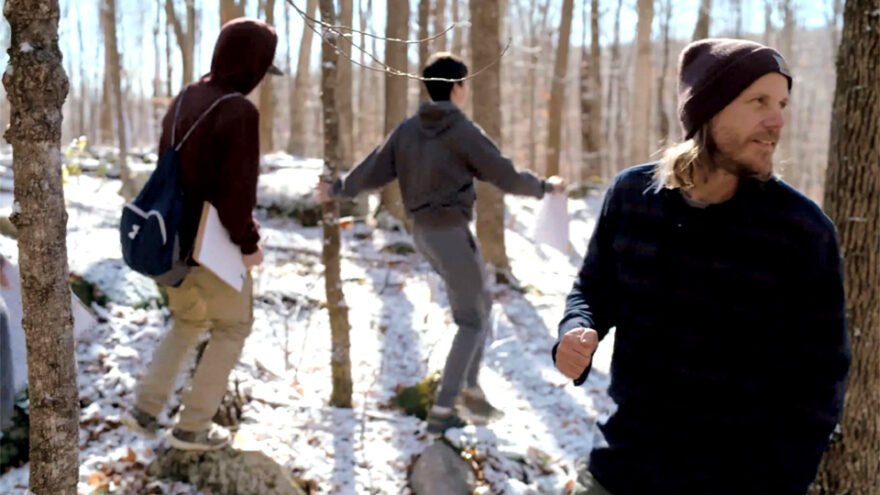
Gone Guys is set in rural Vermont. Throughout its 45-minute runtime, it explores what it calls the ‘quiet crisis” taking place in Vermont and around the country of the increasing isolation and disengagement of boys and young men. The film reveals, through both personal, local stories and with national data, the downward trajectory of an entire generation. Boys and young men are increasingly failing academically, struggling with loneliness, suffering from substance use disorder, and dying by suicide.
Curry was the executive director of the Tarrant Foundation when the film was released. She’d joined the foundation after graduating from Middlebury with a degree in political science and seven years of working at a community foundation in Wyoming. There, she says, she “had the chance to see how philanthropy can address complex issues holistically.” Returning to Vermont with her husband, fellow Middlebury alumnus David Curry ‘96, she became the foundation’s director at its beginning in 2005 when it was launched by the late Vermont businessman Rich Tarrant and his wife, Deborah.
This film, Curry says, was Rich Tarrant’s decision to take “one last big swing.” (Tarrant died in August 2025; the Foundation granted VCF the rights to the film and its residual assets, and Curry joined VCF.) “Boys’ struggles in school had been on his mind since my job interview 20 years ago,” Curry says. “The data was showing worrying trends: declining male college enrollment, workforce drop-offs, higher substance use, incarceration, and suicide rates.”
These trends had been noticed, most prominently by author Richard Reeves. “ Reeves’ book Of Boys and Men was pivotal in informing our decision to make a film.The book frames the issue not as either/or – whether we help boys or support girls through their very real struggles–but as something society can address while still supporting girls and women.” The Foundation brought Reeves to Vermont for some very well attended and meaningful public talks that shone a light on how much the conversation needed to be happening. “We realized we needed something bigger and more lasting. That’s when we decided to make a film.”
Gone Guys’ subject matter is sobering. At a screening of the film in Burlington, Vermont, the audience was filled with concerned-faced parents, educators, community leaders, and a smattering of young men, some of whom had been featured in the film. Watching cleverly animated statistics of alarming data, such as how the suicide rate among young men has increased by one-third in the last 10 years; that men make up 64 percent of those high school students whose GPAs are in the bottom 10 percent; that labor force participation of young men has decreased approximately eight percent since 1960, an uncomfortable stillness settled in across the theater.
But the film was also beautiful, with sweeping shots of Vermont in late fall, of farms and rural schools and woods and fields. There were honest, touching, and ultimately hopeful stories of young men, educators, mentors, and researchers who are finding ways to change the story at the very local level, from Boy Scout troops to experiential learning and afterschool groups where boys can talk about how it feels to be a boy today, and be vulnerable without fear.
Curry says the response to the film has been incredible. “At first we were told that it was going to be an uphill battle getting audiences. Our experience has been the exact opposite–instead we’re trying to figure out how do we keep up with the demand?”
The Foundation has made the licence to screening Gone Guys free to every K-12 school, public library, community colleges, and nonprofit organization in Vermont and $50 elsewhere. “Teachers, parents, and community members who have screened it have shared stories of feeling seen and less alone,” says Curry. “One person described it as ‘like someone putting an arm around me.’ That’s exactly the kind of connection we hoped for.”
Audience members aren’t just reacting. They’re acting. “It’s been extraordinary the number of times I have stood in a room and watched a new community come together in real time” following a screening, Curry says. “The only other reaction I have seen like that has been in response to a natural disaster–this spontaneous volunteering, offering of resources in response to a complex social issue is a different dynamic. In room after room after room, community after community, where I have watched people step forward and start talking about what they’re going to do, from setting up a boy’s group at school to a mentoring program to engaging sports teams and athletic directors to continue the conversation.”
The film’s contents resonate with Curry, too. As the parent of two college-aged students, she’s seen what they and their peers have been experiencing. After seeing Richard Reeves speak in Vermont, the precursor to the film, Curry says her son “texted me the longest message we’ve ever exchanged. He said that for him and his peers, these challenges weren’t news—they’d been feeling them for years. These discussions gave him permission to voice that.”
What’s next? Curry says she thinks that this film will inspire future action in communities and in state legislatures to address the real needs of boys and men, while also continuing to address the needs of other groups on issues like pay equity, safety in relationships, and bullying.
Above all, she’s grateful for this moment. “This project has been extraordinary,” she notes. “I feel like part of the nature of working in philanthropy is that you can stand in a room where a lot of inspiring, heartwarming, hard things happen. What an incredible privilege. Looking back, this has been some of the most potent professional work I have ever been a part of.”
Original published in January 2026, this story was updated in March 2026.
Leave a Reply