
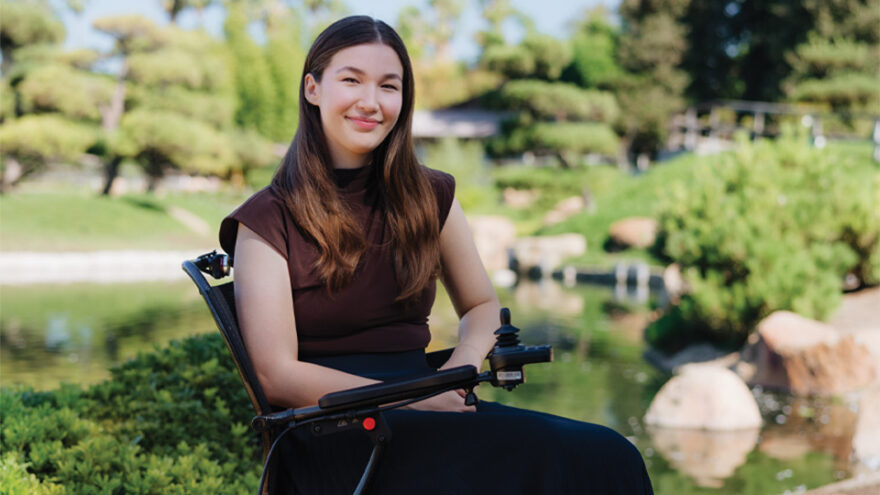
Aubrianna Wilson ’23, a Posse Scholar and first-generation student at Middlebury, may only be 24, but already she has spent years advocating for greater awareness and acceptance of disabled people in society. In August, through a series of emails, she and staff writer Jessie Raymond ’90 had the following conversation.
You graduated from Middlebury in 2023 with a degree in neuroscience and a minor in global health studies. How did you arrive at those choices, and how have they affected your current path?
I joined Middlebury with an eagerness to care for others, which motivated me toward medicine. But along the way, I fell in love with critical disability studies, and I discovered that there are many meaningful paths to helping others beyond health care.
Your disability advocacy activities began at Middlebury, right? AW: Yes. I was an advocate in every space I joined. I was a MiddSafe advocate, a chemistry lab teaching assistant, a resident assistant, a neuroscience research assistant, and a calculus grader. I was a student representative on the Advisory Group on Disability, Access, and Inclusion. I served in the Student Government as a senator and committee director, and was the co-president of a student organization.
What would you say is your most important contribution as a student?
I’m most proud of the Middlebury Accessibility Needs Survey and Report. Over two years, I led a team of student advocates to gather and elevate over 150 voices on the barriers to full participation in the Middlebury student experience. We presented actionable recommendations to senior leadership—empowering student stories for institutional progress toward creating a Middlebury for all.
You were awarded a Watson Fellowship. What made you decide to apply for that, and what was the experience like?
I first learned about fellowships from a dear friend during our junior year. That conversation opened up a world of opportunity, and it speaks to how transformative it can be when we open doors for one another. Disability communities were the heart and driving force of my Watson. It was the greatest gift to spend a year in community with so many fierce, brilliant disabled folks—to immerse myself in disability culture. My Watson was only possible because of all the people who supported my journey.
Traveling abroad can be daunting for anyone; how did you find getting around in all different countries, beyond the usual language barriers and cultural differences? Had you traveled internationally before?
Before my Watson, I had spent no more than a week abroad. In my original proposal, I planned to live in four countries. Listening to local communities transformed my path, guiding me to over 30 locations across eight countries: the United Kingdom, the Netherlands, Belgium, France, Spain, Japan, Australia, and Aotearoa/New Zealand. This adventure continues to shatter my perceptions of what disabled people are capable of, including myself. Disabled people defy the limiting stereotypes placed on us. We are innovators because we live in a world that hasn’t imagined us and still does not embrace us as valuable members. Lessons that I learned and relearned from my disabled mentors and my own lived experience: the myths of the many “can’ts” that get attached to disabled people—we can’t live independently, can’t travel, can’t experience joy. The truth is, we can, and some do, and we want more of us to be able to.
What did your experience abroad teach you about disability across societies?
My Watson celebrated the many ways disabled people create joy together. Disability is a lived experience that is so much more than tragedy. I discovered the power of disabled joy in different national and cultural contexts. Joy as a tool to sustain ourselves and our communities. I grew from every hug, every dance, every cry, every laugh, every goodbye, and every hello. Disabled joy has heavily shaped who I am.
What have you been doing since returning to the U.S. ?
Near the end of my Watson, I sought out opportunities where I could use what I had learned to support my communities. I joined the National Clearinghouse on Disability and Exchange (NCDE) as part of MIUSA (Mobility International USA). As a program coordinator, I supported people with disabilities to access global opportunities and built awareness of disability inclusion in international exchange programs. My position was entirely federally funded by the Department of State; unfortunately, with grant funding cuts, it was eliminated. Now I am thrilled to have joined the American Association of People with Disabilities (AAPD), working as the state voting coalitions coordinator as part of the Accessible Democracy team. I support the REV UP network, serving as the liaison for state coalitions. REV UP stands for “Register, Educate, Vote, Use your Power!” This grassroots movement builds civic engagement in the disability community and improves the accessibility of elections. In practice, this looks like supporting a national network of local organizers by building their capacity and equipping them with the resources and education needed to empower their communities and the disability vote.
You have just returned from a leadership conference. Can you talk about what you did or learned there?
This year, I had the honor to participate in LeadNext, a leadership exchange program that, in its official wording, “builds a vibrant network of future leaders aged 18–25 and supports their growth, impact, and capacity to address today’s greatest challenges.” I just got back from our culminating leadership summit in San Francisco. Through cross-cultural exchanges, our cohort deepened our understanding of how to navigate complexity and collaborate across differences as global citizens.
How do you feel about the current and future progress of disability awareness and accommodation in the U.S.?
As a broader society, we still need to make progress around the basics, understanding that disability is not a problem to be solved or overcome. Disability is a lived experience and a world of expertise. There is progress to celebrate in the history of disability rights and justice advocacy. For example, some universities have disability resource centers that include cultural programming and actively recruit excellent employees who are also disabled. More disabled students are accessing higher education and going on to lead fulfilling lives and careers. We also continue to push against rivers. Discrimination against disabled people runs deep. We still struggle to be recognized as whole, self-determining human beings. My everyday life is grounded in disability community, which is abundant, liberating, and sustaining. It’s also rare. I hope one day we can all live in communities where disabled people are thriving.
What you are most proud of, and what you are looking forward to?
I am proud of my openness to learn. I have been gifted with the most generous of teachers. What I look forward to is an accessible future. I want to honor Sins Invalid, a culture and justice performance group, that reminds us to build communities where we leave no one behind.
What’s next for you, short term and long term?
What comes to mind first is in the short term: I just finished reading The Parable of the Sower by Octavia E. Butler, so I plan on reading the sequel next. When I envision my future, I am grounded in my sense of purpose. One of the many ways my Watson lives on within me is that I continue to embrace uncertainty. Before my travels, I was very plan oriented. I wanted to draw the map before I embarked. But I’ve come to learn that the magic in life often can’t be seen far down the road. So what’s exciting right now? I get to use my skills in problem solving, coordination, and community engagement toward a world that I want to be my future. And what’s next? I hope to continue em‑ powering disability communities.
Leave a Reply