
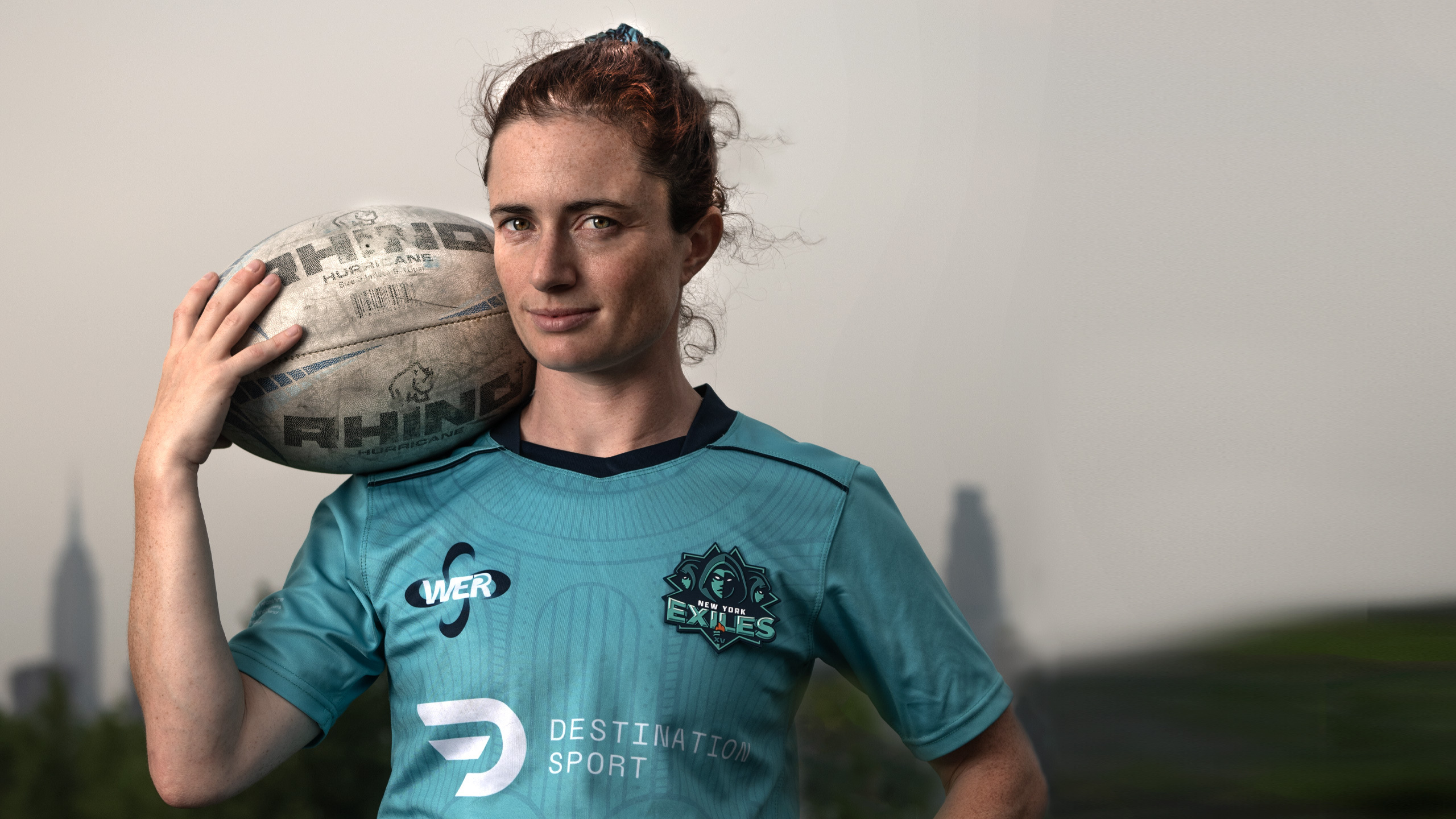
For Sarah Minahan ’14, rugby is all about fun, teamwork, and camaraderie. And tackling.
Today, Minahan—known to teammates as “Mini” since her Middlebury days—plays the pivotal position of scrum half (roughly comparable to the role of quarterback in football) for the New York Exiles, one of the six teams that make up Women’s Elite Rugby. The new women’s professional rugby league’s inaugural season wrapped in June; the Exiles made it to the final game before falling to powerhouse Denver.
Playing at the professional level was perhaps the last thing on Minahan’s mind when she walked onto the field (or “pitch,” in rugby speak) as a first-year. “As a little kid, I was very active, climbing on things and wrestling with my dad and doing gymnastics. But going into college, I didn’t consider myself an athlete,” says Minahan. She ran cross country and track in high school at Boston Latin, but, she says, “it was literally just me and my friends jogging to Dunks.”
Nonetheless, she knew she wanted to play a team sport in college. “I thought it would be cool. It was really about my desire to find a collaborative community and make friends, especially as I was starting college.” The options were few, she says: “There are not that many sports you can just join—basically, there’s Ultimate Frisbee, rugby, and crew.” Crew didn’t seem to offer the team spirit she was seeking, so she thought she’d play Ultimate. “But I was kind of intrigued by rugby, because you could tackle people, and I was interested in that,” says Minahan. “And it just so happened that the first rugby practice was before the first Ultimate practice, so I thought I’d just go and see what happened.” Thus was born a career.
Slightly intimidated, she recruited a friend, Emily Duh ’14, to join her that first day. “We went to the practice,” Minahan recalls, “and it was like, ‘OK, you’re on the team, you’re one of us.’ Everyone is so excited to have you there, and there’s no pretense about not making the team. I was immediately drawn in, seeing that they were all really good friends.”
That first fall, she says, “I remember the social parts. You’re a freshman, and the sophomores would invite you to their dorm, and it was so exciting to be included. And there’s a really fun part of college rugby called ‘singing’ or ‘choir’ that’s done all over the world. You get together on a Thursday night and sing all these rugby songs, which are varying degrees of crude. I thought that was so fun—such a creative, unique way to spend a couple of hours and we’d wear costumes. It felt silly and— well, countercultural is maybe too strong a word, but it was different from just sitting on the floor of the dorm room and then going dancing, which seemed so boring.”
Minahan came for the social aspects but stayed for true love of the game, which soon followed. “I was fully hooked,” she says. Part of the attraction was the tackling. “As a girl growing up, you don’t see or play any sports where girls get to tackle. When you do get to do it, it’s like something very exciting and slightly forbidden.”
Initially, she says, “I struggled a little with my actual rugby skills.” Sophomore year was tough, “and I wasn’t sure there was a spot for me”—one of several moments on her journey to the Exiles when she considered throwing in the towel. She had been playing wing (“where people on college teams who don’t know what they’re doing end up”), but the team’s assistant coach approached her about the scrum half position and spent time helping her learn the role.
It was a good fit. “The scrum half has to be there for every single tackle, to play the ball out,” says Minahan. “Basically, it involves a lot of running and scrappiness. You have to be very fit; you have to be able to hold your own and punch above your weight class.”
In a sport that rewards size, Minahan, at five foot two and 120 pounds, is often the smallest player on the team, so she’s certainly accustomed to punching above her weight; the sobriquet “Mini” derives from both her name and her small stature. But one aspect of the culture Minahan cherishes is that “rugby was the first time I saw women genuinely celebrated for being bigger. People are proud of their size; you’re using your size to do something for the team. That’s a very special part of women’s rugby.”
Minahan is modest about her college play, but those who knew her then say she brought something special to the pitch, even as her skills were still developing. Her Middlebury coach, K.O. Onufry— herself a legend in women’s rugby who played on a men’s team at UMass Amherst in the 1970s (before women’s teams existed) and was a member of six national champion club teams—says, “Mini stood out because of her super attitude, her willingness to help other people, and her great sense of humor and infectious smile. People like her made a difference in our club.” Teammate Duh, who accompanied Minahan on that first day and stuck with the sport through college, says, “She was always the hardest-working player and knew the rules better than anyone. From the beginning, she dedicated herself to being a real student of the game. She always had leadership qualities; that’s why she was voted captain as a senior.”
While living in New York after college, Minahan thought she’d pursue club rugby, joining a Women’s Premier League team. (The WPL was the precursor to the new Women’s Elite Rugby organization.) The first practice was an eye-opener: “I was like, ‘What the F is happening? Maybe I’ve never actually played this sport before.’” She recalls, “They already had play calls; they were talking about ‘running lines.’ I didn’t know what that was, since I had never played soccer and didn’t have context from other sports. Middlebury was a good rugby team—we actually had really talented players and strong athletes—but we didn’t have complex plans.” This was rugby on a whole different level. That year, she says, “I had a lot of fun, but I was completely in over my head.”
Minahan doesn’t hesitate to say she was the worst player on the team, but her skills improved over time. Truly key were the two years she spent in Boston, attending grad school—she holds a master’s degree in speech and language pathology; her day job is as a speech language therapist at a school for children with disabilities— and playing for a local Division I team, a level below WPL. It was a less competitive organization than New York, and the result was that she got lots of playing time and experience. “That’s what really helped me grow from the college level to the elite level,” says Minahan.
Like so much else, rugby shut down when COVID struck. Minahan’s hiatus from the game lasted more than a year. “I wasn’t sure I was going to go back. I was only 27, but I thought, ‘Maybe I’ll retire.’ That was my attitude going into the summer of 2021. I thought I’d give it a try, but I wasn’t going to do it unless it was fun.” She joined a sevens team—the version of the sport played in the Olympics, fielding seven players a side playing seven-minute halves, as compared to the usual 15 players and 40-minute halves—and, she says, “it was awesome, and I still really wanted to play.”
Returning to her New York team in 2022, she found her skills had taken her to the next level, and, she says, “I’ve been a solid member of the team for the past three years.” It was spring 2024 when the WPL players learned that the pro league would soon be launched, just as women’s sports generally seemed to be gaining momentum. “It is our time,” says Middlebury coach Onufry. “Look at basketball and soccer, where they’re going with the game. More and more, there’s an audience for women’s sports.”
The WPL teams—in New York, Boston, Chicago, Denver, the Twin Cities, and the Bay Area—remained and formed the new WER league, and a draft was held for the players, with no guarantee that current players would be invited to join. Minahan, to her delight, was chosen to stay in New York. She wasn’t exactly surprised, she says, but “because of the path I’ve taken to get here, I very rarely just assume I’ll be on a roster.”
Going pro has changed the experience, she says, but perhaps more for the spectators than the players. “Rugby has always been extremely important to me; the difference now is that everyone else cares,” says Minahan. “You slap the word ‘professional’ on it and suddenly people pay attention—they’re following stats, they’re buying merch.” Games are also now live streamed, which helps build a fan base, and the games are played at larger and more fully equipped venues, with jumbotrons and scoreboards.
The sport is drawing ever-larger crowds, and while fans may not know all the famously arcane rules, they enjoy the fast pace and impressive skills on display. “People in general have more fun watching the games than I expected,” says Minahan. And making it to the final game was as exciting as it was unexpected: “At the beginning of the season, we didn’t think we’d be there.” But the chemistry of the team, mostly made up of players who’d been together for years, “ended up being our superpower. The thing that got us there was cohesion and the connections we have on and off the field.”
Without question, Minahan has gotten just what she’d hoped for in joining a team sport—many times over. “I think team sports are just an incredible model for real-life problem solving,” she says. “People on the team have different lifestyles and different jobs, and they bring different things into the space, but we’re all working toward one goal. Yes, it’s just a game, but to have all these women come together and problem solve together is truly inspiring.”
Leave a Reply