
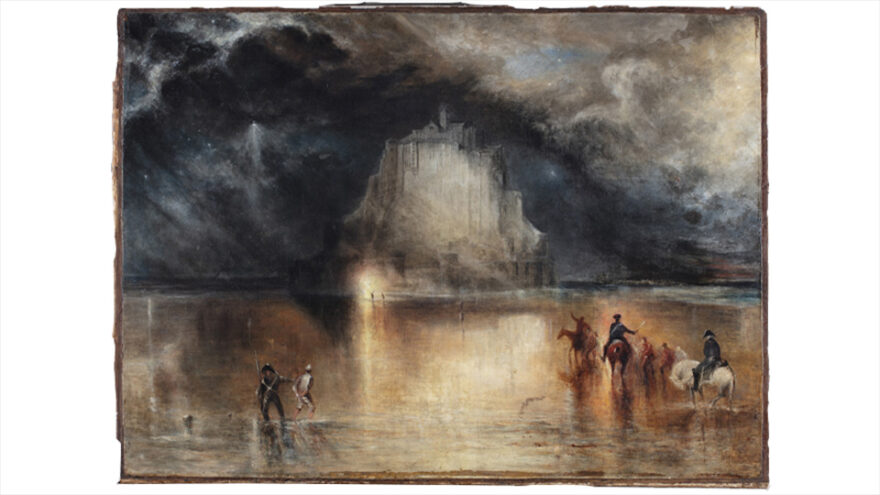
“I am not a Turner specialist,” Pieter Broucke said to a standing-room-only crowd of over 70 people at his Carol Rifelj Lecture last fall in the Hillcrest Environmental Center. It was quite the disclaimer, given that attendees were there for his slide lecture documenting his efforts to confirm (or refute) the authenticity of an unsigned 19th-century work the owners were told had been painted by famed British landscape artist J. M. W. Turner. Broucke’s talk was the third in the 2025–2026 Rifelj series, which features faculty speaking on their areas of expertise or, in this case, a bit outside of it.
Broucke is many things: a longtime professor of history of art and architectural studies, associate dean for the arts, and associate curator of ancient art at the Middlebury College Museum of Art. But he is not a Turner specialist. He has, however, learned a lot about Turner in the several years since he first saw the painting in question, an oil-on-canvas of the French tidal island Mont Saint-Michel.
A Murky Provenance
Broucke was introduced to the work around 2021 by a friend and fellow professor who, along with the professor’s two siblings, has since inherited it from his late father. The three siblings, who have asked not to be named, grew up looking at this roughly two-by-three-foot oil painting in their family home. They knew that their grandfather, a World War I colonel, Commander of the British Empire, and bit of a rogue, had acquired it around 1925 in London with the understanding that it was a Turner. But the painting lacked a clear provenance, and numerous efforts to establish one had fallen short.
The professor’s father, who himself had inherited the painting from the colonel in 1955, had begun looking into its provenance in the 1960s and came across two appraisals of the painting attributing it to Turner. In his retirement, in 2019, on a recommendation by Sotheby’s, he shipped it to London, where it was no longer attributed as a Turner original. Broucke said, “A specialist looked at it for a couple of minutes and said, ‘That horse doesn’t look like it’s by Turner.’ And that was the end of that.” (Broucke, in his lecture, compared the figures in the painting to those in confirmed Turners, and made a strong case that the horse did, in fact, look like it was by Turner.)
Also in 2019, the father sent it to the Williamstown Art Conservation Center in Massachusetts for scientific analysis. The lab there determined the paint was contemporary with Turner’s work, and unusual spiderweb cracks visible on the canvas were consistent with Turner’s tendency to use his brushes with such force that their bristles would crack the not-quite-dry paint layers underneath. Even the presence of a rare pigment was consistent with Turner’s painting practice. Further conclusions, however, were limited because of the painting’s poor condition. It had been relined; that process used heat to press a new canvas onto the back of the original with the intent of stabilizing it. If there had been any identifying writing on the back of the canvas, the new lining had obliterated it.
Though the family had the painting professionally cleaned, the heat of the relining process had permanently darkened the pigments and left the painting’s surface compressed and mirror smooth, crushing any built-up paint strokes, or impasto, that could have linked the painting more closely to Turner.
Enter Pieter Broucke
With years passing and no progress being made on establishing the painting’s authorship, the professor thought his colleague Broucke might be able to help.
At first, Broucke wasn’t sure he had any expertise to offer. “At the time, I did not really know much about Turner. I don’t even do British art. I don’t do 19th-century art. I do ancient Greek and Roman and Egyptian architecture.” But he found himself bothered that the family couldn’t get answers. “As an art historian, I felt an obligation to the object to find out what it was. If this is a Turner, we should know. If it’s not a Turner, the owners should know. Right? Get out of that limbo. I said, ‘OK, maybe I can use some archaeological methodology to push this a little bit further.’”
He went over what the family had learned. He had a couple of Turner experts look at the painting—one of whom thought it could possibly be a Turner, one who expressed no doubt at all. “She didn’t even flinch.” And Broucke, after studying Turner’s life and works, developed his own arguments for why the painting was likely a Turner. But, having reached the limits of his expertise, he said the question came down to “How do we push this forward?” His idea: a lecture.
He told the family, “I will do a public presentation, way, way, way out of my wheelhouse. Let’s make a recording of it, let’s intersplice the images so that this can be sent around to anybody who wants to take a look at it, to make people curious. The idea was to get word about the painting out, in context, with some documentation around it.”
Two of a Kind?
In the October lecture, titled “J. M. W. Turner, Saint Michael’s Mount, and Mont Saint-Michel,” Broucke presented the research and analysis that had been done on the painting before his involvement. Then he turned to a theory he had developed based on archaeological methods of looking at the painting in the larger context of Turner’s body of work. He believed an important clue to the painting’s origins lay in a different painting—this one a confirmed Turner—of Saint Michael’s Mount, a British tidal island near Cornwall that resembles Mont Saint-Michel. In the lecture, Broucke put forth his theory that Turner had painted both, intending them to be displayed as a pair.
Broucke learned that Turner had done other paired paintings “where he compared war and peace, France and England; subject matters that invited comparison.” Broucke thought these two visually similar islands would have made an apt pairing, one that highlighted the economic and political differences between post-Napoleonic France and early Victorian England. Both were tidal islands topped with former monasteries dedicated to Saint Michael, yet Saint Michael’s Mount had developed a thriving economy, whereas Mont Saint-Michel had been turned into a prison.
Turner had visited Saint Michael’s Mount in 1811, and made a finished watercolor of it, and Mont Saint-Michel in 1826, after which he made watercolor studies of both islands. He also did a finished watercolor of Mont Saint-Michel, now in a private collection in San Francisco. He then developed an oil painting, now on display at the Victoria and Albert Museum in London, of Saint Michael’s Mount. Broucke questioned why, having painted watercolors of both sites at approximately the same time, he would have produced a full-size oil painting of only one of the islands. Showing slides comparing the two paintings and the related watercolors, as well as sketches Turner had also made at both sites, Broucke laid out his argument for the oil paintings being a pair.
Still, while Broucke’s theory of a set of paired paintings might support attribution of the Mont Saint-Michel painting to Turner, it doesn’t get around the issue that no mention of the painting has turned up in any inventories or writings by or about Turner. In other words, while no one has been able to prove the painting is not a Turner—by, for instance, positively attributing it to another artist or dating the pigments to the 20th century—there isn’t enough evidence at this time to prove that it is.
What Comes Next
The family now has some decisions to make, such as whether to send the painting out for more testing, an expensive proposition. Broucke doesn’t see the point; the paint and canvas have already been determined to be consistent and contemporary with materials Turner might have used; there’s nothing more to analyze.
But there is one avenue that Broucke thinks should be explored further: several damaged labels on the back of the painting’s stretcher that might reveal useful information. If the lecture recording reaches an expert who can decipher those labels, maybe they will reveal information that helps fill in the painting’s whereabouts between the time it was created and when the colonel bought it in the mid-1920s. “We need to know more about these labels.”
While the family would of course be delighted to own a valuable masterpiece, they also would like to wrap up the story that their late father didn’t get a chance to. One of his children summed it up: “Whatever the value of this thing is—and obviously we hope it’s a Turner—we owe it to everyone, including the work of art, and to our dad, too, to come to some conclusion.”
Putting It Out There
Broucke knew from the beginning it would be hard to prove the painting was a Turner. But his careful comparison of the Mont Saint-Michel and Saint Michael’s Mount paintings has convinced him. “I think it is a Turner, and on top of that, I think it’s an important Turner because it’s part of a pair. And I think it’s part of a very effective pair. If it ever goes to London, it should be displayed next to the other Turner, because that, I think, would make the point.”
However, it will take stronger evidence and consensus by more experts in the art world before the painting gets the attribution the family is hoping for. Given that he is not—lest anyone forget—a Turner specialist, the best Broucke could do was present everything he could and hope it reaches a wider audience.
He ended the lecture with a final word of self-deprecation. “I hope it’s going to find its way into the hands of people who know more about Turner than I do.”
See the video here. https://vimeo.com/1133481546?share=copy&fl=sv&fe=ci
Leave a Reply