Middlebury Magazine

  • Recent Stories
  • Menu
    • Features
    • Essays
    • Q&A
    • Podcasts
    • Review
    • Videos
    • About
    • Advertising
    • Contact
    • Support
    • Writers’ Guidelines
  • Search

Fall 2018 Road Taken

A Return to Manual Labor

A writer decides to roll up his sleeves and approach work in a different fashion.

By Paul Barnwell ’04, MA English ‘13
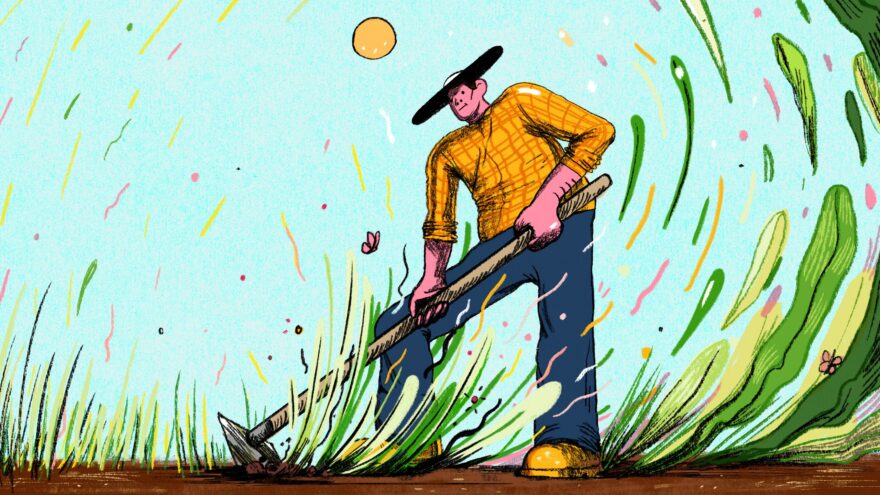
Illustration by Annelise Capossela
November 1, 2018
  • Facebook icon
  • Twitter icon
  • Email icon

During a late May morning on a farm on the outskirts of my hometown of Concord, New Hampshire, I join the other farmhands in walking down the row of Fraser fir Christmas trees, two years old and barely up to my knees, sprinkling pellets of fertilizer around the outer edge of the lower branches.

Take two steps.

Repeat.

Two steps.

Repeat.

When we reach the end of the row, we fill up our plastic pails with fertilizer and journey back up the gently sloping hill. Upon reaching the top, the farmer, a 40-something, broad-shouldered hockey player—who can fix everything, from backhoes to weed wackers—gives us a reminder.

“Make those roots reach for the nutrients,” he tells our crew of four, including me, a retired Army veteran, and two local college students.

I embrace the repetitive and meditative work. It’s hot in the bright sun, but there’s a breeze that cools the sweat just enough to make it bearable. I’m working for wages a fraction of my previous job, but the rewards make up for the loss in pay. The work is a constant reminder that using my hands and body, feeling accomplished after seeing tangible results, is something that many folks of my generation are—or perhaps should be—longing for.

I’m well aware that my choice of part-time employment comes from a position of privilege. I don’t have to work 40-plus hours a week spreading fertilizer, pulling weeds, and straining my body day after day. My wife, Rebecca, carries our benefits, and after some international travel, we’re living at home with my dad in my childhood home. And yet I’ve always enjoyed physical work.

My summer jobs during high school and college included working for a moving company, preparing textiles and rugs for shipping, and stacking pallets of beer by night in a refrigerated warehouse.

After graduating from Middlebury in 2004, I worked as a public school teacher in Kentucky, but I didn’t stop embracing activity that was grounded in making and doing.

During afternoons and evenings, I experimented and toiled in my urban garden, keeping a small flock of hens that our neighbor would sometimes find roaming in the alleyway or hiding underneath his pickup truck. I brewed beer and hunted white-tailed deer on weekends and evenings, learning to do everything from calibrating my compound bow to scouting for tracks and field dressing the carcass.

It all served as a salve for teacher stress, a respite from grading papers, angry parents, and having to make thousands of decisions every day in the classroom. I suffered from bouts of depression, but when I was moving and outside, I activated a different part my brain. The disconcerting fuzz of radio static in my head dissipated with every pulled weed.

Earlier during that May morning at the farm, our crew labors over pruning highbush Jersey blueberries. The morning dew saturates my work boots, and by 9 a.m. I shed my thin outer layer. After we pile the discarded branches at the end of the rows, our boss deftly handles the bucket loader as he maneuvers and mashes the small mountain of tangled branches, scoops them up, and reverses course to dump the limbs in the corner of a field for what will undoubtedly become a bonfire on a cool fall evening.

Before we start fertilizing the infant Christmas trees, I take a moment and think about what a friend and fellow Middlebury grad told me earnestly after I informed him about my farmhand work. “It’s going to be good for the soul,” he said.  So far, he’s right.

And I can’t help wondering just how much better off many of us would be—physically, mentally, and spiritually—if we valued healthy doses of active work as much as the countless jobs that require sitting still, staring at a screen, and hoping that our emails and mouse clicks have a measurable and positive impact on the world around us.


Leave a Reply Cancel reply

Your email address will not be published. Required fields are marked *

Recent Stories

Features

Pitch Perfect

Sarah Minahan ’14 finds success in the first professional woman’s rugby league in the U.S.

By Jane Dornbusch
Photograph by Robert Clark
February 1, 2026

In Conversation

Middlebury President Ian Baucom sits down for an extensive interview with magazine editor Matthew Jennings.

By Matthew Jennings
Photograph by Brett Simpson
January 3, 2026

A Dog’s Life

A filmmaker takes us into the minds of the animals who are part of our families.

By Sara Thurber Marshall
Photographs by Randal Ford and Steve James
April 4, 2025

The Worrying Dude

Matthew J.C. Clark '04 is a writer and carpenter who defies convention

By Josh Billings ’03
Photographs by Tara Rice
April 3, 2025

Dispatches

Unattributed

A Middlebury professor reaches out for help solving a three-generation art mystery.

By Jessie Raymond '90
February 5, 2026

Words & Music

NPR dropped in on a German for Singers class designed to give language students an edge when competing for roles in German-language operas.

By Matt Jennings
Illustration by Edel Rodriguez
October 8, 2025

Horse Sense

Middlebury has a vibrant equestrian scene.

By Sara Thurber Marshall
Photograph by Yeager “Teddy” Anderson ’13.5
September 23, 2025

The Economics of Health Care

Students in Health Economics and Policy course help shape Vermont healthcare reform.

By Jon Reidel
Photographs by Daria Bishop
July 31, 2025

Thanks for the Memories

A student-curated exhibit explores the Middlebury experience through more than a century of undergrad scrapbooks.

By Jessie Raymond '90
Photographs by Todd Balfour
May 5, 2025

Fear Factor

A scientific model—and work of art—warns of the next pandemic.

By Jessie Raymond '90
Photograph by Jonathan Blake
April 4, 2025

From NESCAC to NFL?

Thomas Perry '25 has a shot at playing football on Sundays.

By Matt Jennings
Photograph by Rodney Wooters
March 11, 2025

Words in Space

A NASA interpreter bridges the language gap, one mission at a time.

By Jessie Raymond '90
Illustrations by Davide Bonazzi
February 15, 2025

Keeping Her Stick on the Ice

An alumna’s passion for ice hockey puts her in the record books.

By Sara Thurber Marshall
Illustration by Connie Noble
January 26, 2025
View All

Essays

Writing & AI

I used to identify as a writer. Now that’s changing.

By Paul Barnwell '04, MA English '14
Illustration by Petra Peterffy
February 8, 2026

Q&A

Aubrianna Wilson, Middlebury Class of '23, seated in her wheelchair in a California garden

37 Minutes with Aubrianna Wilson ’23

A recent alumna isvdoing her part to create a world in which people with disabilities are seen—and celebrated.

By Jessie Raymond '90
Photographs by Joyce Kim
February 5, 2026

Quotation

A summer immersed in a language can do wonders, as veterans of Middlebury College’s famous language-learning program can attest. The lockdown is clearly going to amount to the equivalent of about two summers, and there are mini-Middleburys happening in millions of houses worldwide.”

—John McWhorter, writing “The Coronavirus Generation Will Use Language Differently” in the Atlantic.

Podcasts

The Exit Interview with Middlebury President Laurie L. Patton

With her presidency at Middlebury coming to an end, the host of this podcast becomes its final guest.

By Middlebury Magazine Staff
December 18, 2024

The Monterey Trialogue: A Distinct Take on Superpower Diplomacy featuring Anna Vassilieva and Peter Slezkine

Our guests for episode six of season three are Anna Vassilieva and Peter Slezkine, the folks behind the Monterey Trialogue—which brings together leading experts from the United States, China, and Russia for in-depth discussions of their countries' interests and concerns in the vital regions of the world.

By Middlebury Magazine Staff
July 19, 2024

Education as the Great Equalizer, featuring Annie Weinberg ’10

Our guest for episode five of season three is Annie Weinberg '10, the founder and executive director of Alexander Twilight Academy, an educational catalyst program in Boston, Massachusetts, that supports students from under-resourced backgrounds.

By Middlebury Magazine Staff
March 14, 2024

Review

Facing Facts

The producer of the documentary Gone Guys reflects on the very real struggles of today's boys and young men.

By Caroline Crawford
January 21, 2026

Editors’ Picks for November and December

By Middlebury Magazine Staff
December 20, 2025

Editors’ Picks for September and October

By Middlebury Magazine Staff
October 24, 2025

Videos

Green Haven

Middlebury's Bi Hall greenhouse is much more than a botanical laboratory.

By Brett Simison
February 8, 2026

The Exit Interview with Middlebury President Laurie Patton

With her presidency at Middlebury coming to an end, the host of the MiddMoment podcast becomes its final guest.

By Chris Spencer
Audio by Mitch Bluestein
December 20, 2024

Creating Community Through Hip Hop

For three days in March, the sounds, styles, and fashions of global hip hop converged on Middlebury for an electric symposium.

By Jordan Saint-Louis '24
April 17, 2023
Middlebury College
  • Alumni
  • Newsroom
  • Contact Us
  • icon-instagram

The views presented are not necessarily those of the editors or the official policies of the College.

© 2026 Middlebury College Publications.