
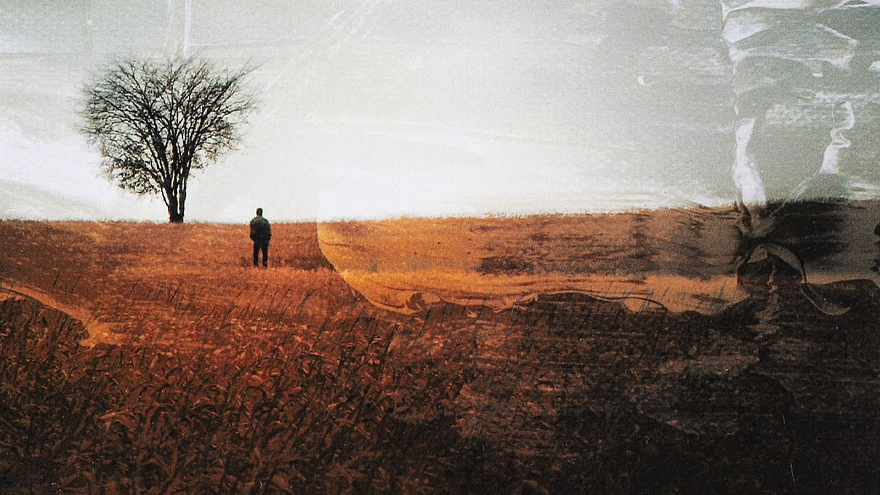
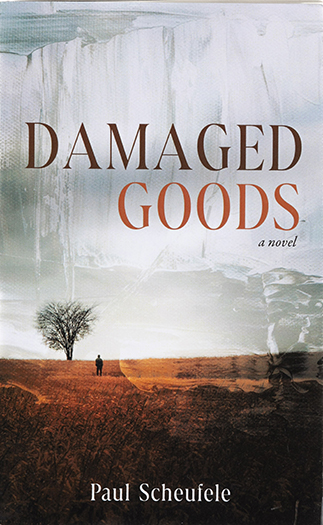
Paul Scheufele ’80 has published his first novel, Damaged Goods, a story about family relationships, ethical dilemmas, and redemption. The narrative follows Brendan O’Shay, a high-powered Wall Street trader during the 2008 global financial crisis, who must deal with issues not only at work but also in his family as he struggles in his relationship with his estranged sister, Cassie. When Cassie dies suddenly, Brendan must explore his feelings about her in a completely unexpected way. Middlebury Magazine sat down with Scheufele for a Q&A about writing his novel.
You were on Wall Street for 25 years. Why did you leave?
I left Wall Street at age 52 because I felt financially secure enough and still young enough to pursue two life goals I developed while a student at Middlebury—teaching high school English and writing a novel.
How did you get started on a novel?
I built the novel off a short story that I wrote for my very first writing workshop at the Fine Arts Work Center in Provincetown, Massachusetts. It was about a conflict between adult siblings, Brendan and Cassie O’Shay. During that workshop, I was given enough encouragement to try to turn that into a novel. I began to look for an inciting incident, the piece of the novel that gives it narrative drive, and that became Brendan’s inheritance of his late sister’s frozen eggs. Once Cassie had passed away, I needed to enable Brendan’s reflections back on the brother/sister relationship in a way that he could gain some form of redemption.
Where did you get the frozen eggs idea?
It was serendipity, really. I was driving and listening to NPR. The radio show host was talking about the proliferation of frozen embryos in storage facilities around the country and the problem it was creating from moral, financial, and legal perspectives. And I thought, wow, I do like to deal with ethical dilemmas. I felt something like this could really work. I decided to use frozen eggs instead of frozen embryos because it gave me more alternatives as to which way the story could go.
What did you know about frozen eggs?
Nothing! I had to do a lot of research because I knew nothing about the in vitro fertilization process—the status of it or the state of it in the 1980s, when these eggs were frozen, or the viability of eggs lasting for over 20 years until they were actually utilized.
You had your story. What was the process you went through to write this novel?
It’s like you really have to believe in yourself, maybe even when you don’t believe in yourself. The process was a lot of work and setbacks, resilience, and continuing at it. I got a lot of feedback from instructors as well as classmates in workshops. I had never written long-form fiction, so I was learning how to do it as I went along.
Tell me how you developed the storyline. You really wanted to focus on the siblings, right?
Yes, I was aware that there are a lot of fractured sibling relationships. In this particular family, there’s intergenerational alcoholism, and I wanted to deal with how that impacts the children. I took the two, Brendan and Cassie, and wanted to show how one escapes that curse and the other succumbs to it. What happens to them as adults? It created a lot of conflict between them; they were estranged but then they tried to reconcile and it didn’t work. I was trying to find, beyond the difficulties, the good things that could come in these relationships. I wanted to deal with this idea of reconciliation after death and the experience of trying to decide what one does with the eggs of a deceased person who never had children. The idea of procreation after death really struck me as a profound thing to explore.
In Part Two, Memoir and Remembrance, the reader really gets to know Brendan and Cassie. How did you develop that section?
It was always my plan to show Brendan’s and Cassie’s backstories. However, I didn’t want to write the book in chronological order because it would take too long to reach the inciting incident of Brendan inheriting Cassie’s frozen eggs. I chose to use a story structure of present-day conflict, a backstory leading up to it, and then a return to the present-day resolution. I wrote it as a memoir that Cassie writes late in her life to give to her brother, so he can understand her experiences and emotions over the years. Once I had her story written, I tried to put myself in Brendan’s shoes. How would I react to receiving my sister’s memoir after her death? Since her memories are mostly episodic, I decided to have Brendan respond to Cassie’s life episodes with his own remembrances about his life then and his interactions with her.
How about the ending? Your resolution was quite unexpected.
I wasn’t sure how the story was going to end for most of the writing. There was a character I had introduced early in the novel, and then that character basically left the story. I realized I hadn’t written that subplot, and I needed to figure out if that character was going to be in the story or not. Once I made a decision, that character became essential to the conclusion of the story and to what Brendan ultimately does with his sister’s frozen eggs.
When did you feel like you had a viable novel?
I came to what I thought was the end of the story, and I passed it along to a college friend who has worked his whole career in the publishing industry. I was prepared for him to say it was a fun thing I had done, interesting, cute. But he said, “Wow, this thing really has potential. I think this could be a really good story. But it’s not there yet.” So I worked with one of my writing instructors who became my editor. That’s when it really started to blossom but also became rigorous and difficult in revising.
So you finished the novel and self-published it. How did you get the word out about it?
It’s funny because people would ask me, what’s your social media presence like? And I would say, zero. I don’t live in that world. But I’ve had to do it, get all the social media sites, post frequently. And it’s been unbelievable how many connections and reconnections I’ve made through the process. The Middlebury community has been really helpful. A number of people have had private book readings in their homes for me or sent out email blasts, things like that. And I have contacted a lot of bookstores around New England.
What’s next?
I have a second novel that will be coming out next year. This one went a lot more quickly than the first!
Leave a Reply