
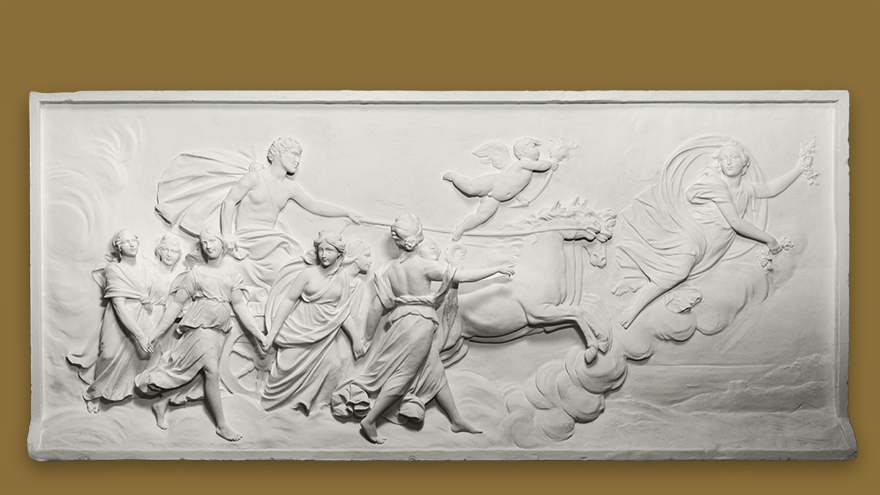
In December 2024, the Middlebury College Museum of Art was offered an early-20th-century plaster relief depicting a popular classical subject: the goddess Aurora and a group of women representing the hours of the day leading the chariot-driving god Apollo toward sunrise. Modeled after a 1614 Italian ceiling fresco by Guido Reni, the relief had been made around 1910 by A. Losi and produced by the Boston Sculpture Company in Melrose, Massachusetts.
Unfortunately, in its state—riddled with cracks and degraded, with several pieces broken off—the relief was too damaged for the museum to accept. But Pieter Broucke, associate director for the arts, saw an opportunity: he reached out to students asking if any of them, with support from faculty and outside professionals, would like to try restoring it. One of several who responded was then-sophomore Victoria Perez Hidalgo ’27, an architectural studies and earth and climate sciences major who had no relevant experience but was intrigued by the idea of restoring a piece of art.
The Challenge
Perez Hidalgo was tasked with the first, mostly low-tech aspects of the restoration: stabilizing the broken plaster, building a backing and frame for the nearly six-foot-long piece, and cleaning the surface. That work would take place in the Makerspace, located on the ground floor of the newly renovated Johnson Memorial Building. Going on three years old, the Makerspace is a workshop, open to all students, that offers training and support for everything from woodworking and CNC milling (an automated process that uses computers to control machine tools) to 3D printing, laser cutting, and robotics.
Before she could begin the restoration, however, in spring 2025 Perez Hidalgo had to take Introduction to Industrial Design, led by Daniel Houghton, director of the Makerspace. There, she learned to use and get comfortable with the tools and equipment in the Makerspace’s woodshop.
In September, she enrolled in Houghton’s Design Lab, where she quickly learned that beyond knowing how to operate machinery, she would have to figure out how to make the repairs on the heavy piece, which required two people to carry it. “The biggest mystery was how to restore the cracks, because there were a lot. And it was very wobbly. When we would move it outside, where I could work on it, I felt like it was going to break any second.”
While she did almost all the hands-on work herself, she relied on guidance from people with more expertise, including Houghton, whom she calls an “amazing mentor.” John Houskeeper, a retired preparator at the Museum of Art who had helped restore some of Middlebury’s other plaster reliefs, advised her on the plaster repair: she ultimately used a small saw to cut grooves in the plaster perpendicular to the cracks, joined the cracks using small steel rods, and epoxied over the joints. For help with the rigid backing that would keep the relief from shifting in the future, Perez Hidalgo says she turned to local retiree and Makerspace volunteer Peter Beckett, whose input cut her work time “in half.”
After her final steps of building the wooden display frame and cleaning the plaster, Perez Hidalgo reluctantly handed off the relief to others. “I just felt so honored that I had the opportunity to work on the piece, and I felt very touched by it in the end. I would look at it and think, ‘We spent a whole semester together, just the two of us.’”
High-Tech Tactics
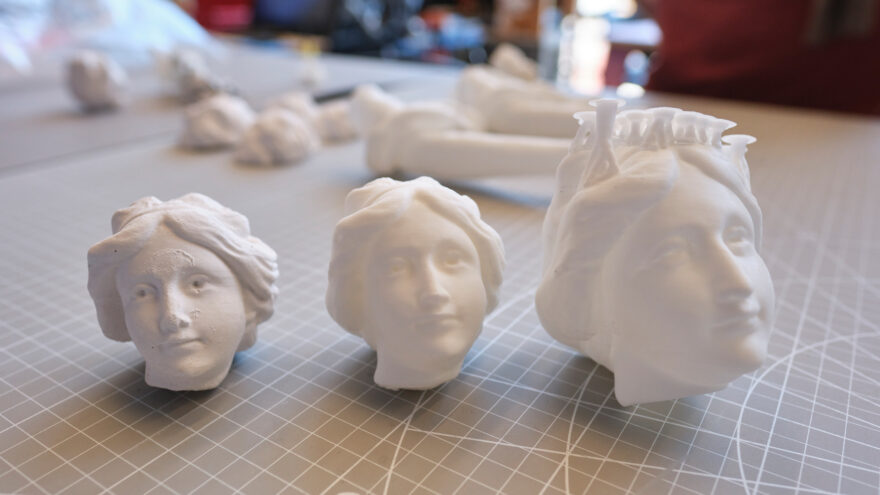
Next up: replacing the relief’s missing and broken parts, which included a set of clasped hands and forearms and the head of one of the female figures. Late in the semester, Menen Ebrahim ’26, a studio art and psychology joint major, heard about the project; a student who had begun to work on creating plaster replacement pieces using 3D-printed molds couldn’t finish, so she jumped in. She felt she had explored just about every artistic medium available to studio art majors except 3D printing, and she was eager to give it a try. With Houghton’s help—and images of the original Reni fresco and a matching plaster relief Broucke had found online for reference—she got to work.
She started learning the 3D scanning software and scanned the sculpture several times. However, figuring out how to generate models the way she had envisioned proved more complicated than she had anticipated.
Houghton says this is something students often encounter. “There’s nothing more humbling than a physical problem that you thought would be easy, and you suddenly realize it isn’t.” He considers this is a valuable, almost necessary, part of learning. “You should be allowed to have an idea, be totally wrong, figure that out, then reassess, then proceed toward some sort of achievable goal.”
Ebrahim kept at it and got as far as beginning to 3D sculpt the molds when she ran into a problem: the looming deadline of her senior thesis. Realizing she didn’t have time to focus on both, she decided to step away from the plaster relief project. Houghton says this happens sometimes, but it doesn’t make her experience less valuable. “You’re allowed to off ramp from things. That’s part of college in general: getting exposed to new things and taking what you want to take out of it.”
In the end, he completed the project, fashioning the plaster replacement pieces, attaching them to the relief with small dowels, and painting the plaster in a matte white finish.
The Takeaway
Looking much like it would have in 1910, the relief is now on display among others in the Mahaney Arts Center. Broucke is pleased but not surprised that the project succeeded. “My sense is that, with proper oversight and preparation, there is a lot students can do. They tend to rise to the occasion.”
In addition to learning new techniques and challenging their creative problem-solving skills, Perez Hidalgo and Ebrahim got their first glimpses into the field of museum studies. Perez Hidalgo says that until she got involved with the relief, she was focused on the environmental and scientific sides of designing and building and had never thought about museum work as a possibility for her future. The satisfaction of seeing the piece be able to sustain its own weight through her efforts has made her more interested in restoring art in the future. This semester, while studying abroad in Spain, she will be interning at an art gallery and “going to a lot of museums.”
Ebrahim was similarly affected. “For learning how to conserve art pieces—sculpture, specifically—I am eternally grateful. I didn’t even know this was a field.” While she plans to work in gallery curation immediately after graduation, she says, “I’ve learned skills for my future career in the arts and museum work.” And, with her thesis now behind her, she isn’t done with 3D sculpture. “I think having more free time to explore different mediums and be working on my own art is more important than being in a classroom. I think I’m gonna be in the Makerspace way more this semester.”
A Makerspace Masterpiece
Restoring the plaster relief required the students to identify and solve problems as well as apply new physical skills to reach a practical end—a process Broucke calls an “experiential learning dream.” To Houghton, that’s the beauty of the Makerspace: it challenges students to use not just their heads but also their hands, an important aspect of education that he believes is often overlooked in the liberal arts. “Does it have to just be heady, analytical, intellectual labor?” he asks. “Physicality feels like a part of it.”
Perez Hidalgo would agree, saying of the Makerspace, “It’s a very special place that is just mind, body, and soul fulfilling. There aren’t a lot of spaces like that.”
Leave a Reply