
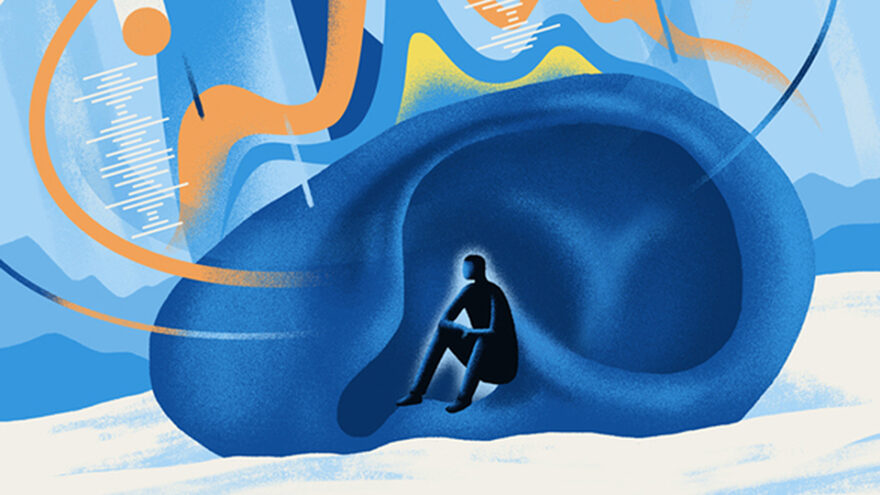
On an early March evening, a crowd of over 100 attendees gathered in a large classroom in the Axinn Center at Starr Library for an event titled “The World According to Sound.” We sat in long rows of student desk/chairs facing the front of the room. Given the black sleep masks waiting for us on each desk, however, it was clear there would be nothing to see there or anywhere else in the room.
The event’s creators, Middlebury alum Sam Harnett ’06 and Chris Hoff, had become friends while working in public radio, Harnett as a reporter, Hoff as a sound engineer. Fascinated with sound production but growing tired of the typical public radio format, they created a 90-second podcast featuring unnarrated sounds. From that, they developed this 70-minute live event, which they take to schools, businesses, and public venues around the country, and a COVID-era home version meant to be enjoyed through headphones. Their mission: “We believe intentional, communal listening is a way to reclaim autonomy in a visually dominated world that is increasingly fracturing our attention.”
In Axinn, Harnett and Hoff busied themselves making last-minute adjustments to various wires and the eight pole-mounted loudspeakers set up around the perimeter of the room. The space soon filled with more people than the free ticket reservations had allowed for, but Harnett and Hoff accommodated them, handing out extra sleep masks like flight attendants on a red-eye.
The lights went down, we put on our masks, and we waited.
At first, we heard Harnett and Hoff chatting, seemingly from opposite ends of the room, running wires and discussing speaker placement. But this wasn’t live; it was a recording setting the scene in our minds, getting us used to the sensation of interpreting our environment without our eyes.
Then the real sounds started. One of the first was a thick, slurping sound, for which we were given no context. For several minutes we listened to the intermittent plops and gloops around us, some nearby, some many feet away. I heard liquid and air, but I couldn’t come up with a mental picture. Could it be clams in the sand? Snorkelers breathing? Frogs in a pond?
Eventually, Harnett (or maybe Hoff) interjected to explain that we had been listening to Yellowstone “mud pots,” bubbling mud formations found in acidic hot springs with low water levels. Never having seen mud pots, however, I couldn’t picture them. I hadn’t ever noticed before how frustrating it feels to be unable to produce a mental image to match a sound.
The mud pot noises gave way to others. Contact microphones, which pick up sounds through vibrations rather than airwaves, relayed the footsteps of an army of ants marching overhead and the metallic snapping and twanging of five different bridges, each with its own sound patterns, as traffic rumbled over them. We heard the wildlife of Yellowstone. We felt the unsettling vibrations of ultra-low-frequency sounds made by an earthquake.
Meanwhile in the Axinn classroom, somewhere behind me, a chair grated and squeaked every time its occupant moved, irritating me. I was trying to hear things.
Eventually, overwhelmed with these immersive and sometimes confusing sounds, I lost track of time. Maybe I got distracted or went into a meditative state. Whatever was happening, it couldn’t have been unique, because just then Harnett and Hoff came through the speakers to let us know that we were about halfway through the hour-plus event. They said it wouldn’t be unusual if our minds had started drifting, but I still felt like I had let them down. Chagrined, I refocused my attention.
Other sounds, mostly human, followed one after another. A professional “sound consultant,” himself sightless, reacted to a series of bottles being opened and described how the various sounds could affect consumers’ perceptions of the products inside. We listened to caps being twisted, popped, and snapped open, and I noticed that each one made me feel a different way: relieved, startled, thirsty. For the first time, I wondered whether I often made purchasing decisions based on sound-based subliminal marketing techniques.
We heard a men’s chorus singing echoing harmonies of ancient Byzantine music in the vastness of Istanbul’s Hagia Sophia, a 15th-century mosque noted for its acoustics. During a Q&A after the show, however, Harnett and Hoff explained that it was a trick; in reality, the chorus had been recorded in a studio. Sound engineers had recorded the popping of a ballon in the mosque. Back in the studio, they used that recording to create a “sonic fingerprint” of the mosque’s acoustics and digitally apply it to the men’s voices. My ears couldn’t tell the difference, so not only was I picturing myself in a space I’d never been, I was also experiencing a performance that had never actually taken place there.
The final segment of the event was a recording of a “silent symphony” by modernist composer John Cage, in which the orchestra sat without playing for four minutes and 33 seconds. The “symphony” was the ambient noise in the concert hall, such as audience members occasionally coughing and shifting in their seats.
It was an apt conclusion to “The World According to Sound,” reminding us that all sounds—the planned and the unintentional, the rehearsed and the spontaneous—are significant. All have the power to provoke sensations and emotions, even if we are not always consciously aware of them.
As we removed our masks and returned to the visual world—with the lights accidentally being turned on so abruptly that the crowd winced and groaned—I wondered who the persistent chair squeaker behind me had been.
Somehow, I felt like I owed them an apology.
Leave a Reply